Winging of Scapula
Treatment in Noida
Your shoulder blade protrudes abnormally from the back — sticking out like a wing when you push against a wall or lift your arm. This is scapular winging: the visible result of a specific muscle or nerve problem that leaves the shoulder blade unsupported against the chest wall. Far more than a cosmetic concern — it causes shoulder pain, weakness, and loss of overhead function that directly impacts daily life. The right physiotherapy in Noida and Greater Noida West — targeting the exact muscle and nerve involved — restores scapular control and full shoulder function in the majority of patients without surgery.




Recognize the Signs of Scapular Winging
Winging of Scapula:
Why the Shoulder Blade Protrudes — and How Physiotherapy Corrects It
The scapula — the shoulder blade — is one of the most mechanically important bones in the upper body. It serves as the mobile platform from which all shoulder movements originate, rotating upward during arm elevation to maintain subacromial clearance, tilting posteriorly to allow full overhead reach, and providing the stable base from which the rotator cuff muscles generate force. The scapula performs all these functions correctly only when the muscles that control it — particularly the serratus anterior and the trapezius — are functioning normally. When either of these muscles is weakened or paralysed, the scapula loses its controlled relationship with the chest wall and "wings" — the medial border or inferior angle protrudes abnormally away from the ribcage, most visibly during arm movements and weight-bearing.
The most common cause of scapular winging is weakness or paralysis of the serratus anterior muscle — the muscle that originates from the lateral ribs and inserts along the entire medial border of the scapula, holding it flat against the chest wall and rotating it upward during arm elevation. The serratus anterior is innervated by the long thoracic nerve, which has an unusually long, superficial course along the lateral chest wall that makes it vulnerable to injury from direct compression (heavy backpack straps, prolonged pressure on the lateral chest), blunt trauma, traction during contact sports, and viral neuritis. When the long thoracic nerve is injured, serratus anterior loses its innervation and the medial scapular border is no longer held flat — producing the characteristic medial scapular winging that is most visible when the patient pushes forward against a wall with their arms extended.
Less commonly, winging results from weakness of the trapezius muscle — innervated by the spinal accessory nerve — producing lateral winging where the inferior angle and lateral border of the scapula protrude, most visible when the arm is abducted to the side. Accurate clinical differentiation between medial and lateral winging — performed by a trained physiotherapist during the initial assessment — is essential because the rehabilitation approach is completely different for each.
At 360 Neck Shoulder Advanced Rehabilitation Centre, Sector 73 Noida — serving patients from Noida and Greater Noida West on the main connecting corridor — our scapular winging protocol begins with precise clinical diagnosis of the winging type and nerve involvement, followed by targeted retraining of the specific muscle and nerve responsible, and progressive scapular control rehabilitation that restores normal shoulder blade mechanics and eliminates the secondary shoulder pain that winging produces.
Types, Causes & Risk Factors
Medial vs Lateral Winging:
Different Nerves, Different Muscles, Different Treatment
The clinical distinction between medial and lateral scapular winging determines the entire rehabilitation approach — and is one of the most important assessments in the initial physiotherapy evaluation.
- Medial Scapular Winging — Long Thoracic Nerve and Serratus Anterior: The most common presentation. Medial border of the scapula protrudes, most visible during forward wall push or arm flexion to 90 degrees. Causes include heavy backpack compression of the lateral chest wall — a significant concern for students and professionals across Noida and Greater Noida West carrying heavy bags on long commutes from Gaur City, Mahagun Moderne, Crossings Republik, and Noida Extension — direct blunt trauma to the lateral chest, contact sports, viral neuritis (Parsonage-Turner syndrome), surgical complications of chest or axillary procedures, and prolonged lateral decubitus positioning.
- Lateral Scapular Winging — Spinal Accessory Nerve and Trapezius: Inferior angle and lateral border protrude, most visible with the arm abducted to 90 degrees. Causes include neck surgery (particularly lymph node dissection) that injures the spinal accessory nerve, blunt cervical trauma, and in rare cases tumour involvement. The middle and lower trapezius fibres — which elevate, retract, and depress the scapula — are the primary rehabilitation targets.
- Functional Scapular Winging from Muscle Imbalance: A common presentation at our physiotherapy clinic in Noida — scapular winging without true nerve injury, resulting from severe serratus anterior and lower trapezius inhibition secondary to poor posture, chronic shoulder pain, or imbalanced training. Desk workers from Noida's IT sectors and Greater Noida West's residential communities who sit for long hours with rounded shoulders develop progressive serratus anterior inhibition that produces a functional winging pattern visible during overhead activities and wall push-up tests. This type responds most rapidly to targeted physiotherapy.
- Voluntary or Habitual Winging: Some patients — often younger individuals — can voluntarily produce scapular winging through selective muscle contraction. While this may appear to be a structural problem, the management is neuromuscular retraining and postural habit correction rather than nerve or muscle rehabilitation.
TECAR Neuromuscular Facilitation & Robotic Scapular Retraining
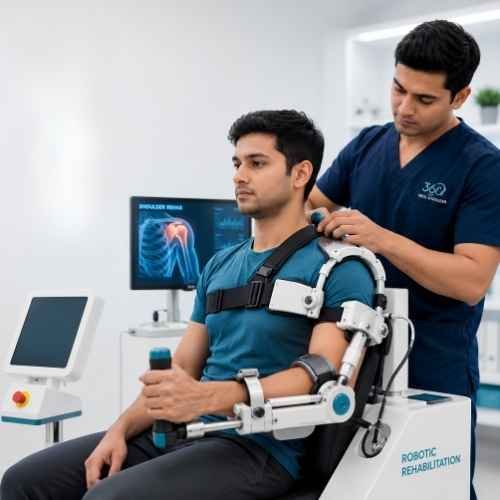
Our TECAR Capacitive mode applied to the serratus anterior and lower trapezius muscle bellies increases local blood flow, reduces inhibitory pain signals in atrophied muscle tissue, and enhances motor neuron excitability — facilitating the earliest possible neuromuscular activation in a muscle recovering from nerve injury or prolonged inhibition. Our robotic shoulder system then delivers progressive, tension-monitored serratus anterior and trapezius loading in precise scapular control movement patterns — building the controlled, endurance-based muscle activation that restores sustained scapular stability through a full working day.
Precision Retraining
Our Identify–Activate–Stabilise
Three-Stage Scapular Winging Physiotherapy Protocol
Scapular winging rehabilitation at 360 Neck Shoulder — serving patients from Noida and Greater Noida West at Sector 73 — begins with precise identification of the winging type, targets the specific muscle and nerve responsible, and progressively rebuilds the scapular control that restores full shoulder function.
Stage 1 — Identify: Clinical Assessment and Neural Recovery Support (Weeks 1–6)
The first priority is accurate clinical diagnosis: distinguishing medial from lateral winging, assessing whether nerve injury is present and its approximate severity, identifying any secondary shoulder consequences of the winging (rotator cuff overload, impingement, upper trapezius hypertonicity), and establishing a baseline of current serratus anterior and trapezius strength. Where nerve injury is suspected, TECAR Capacitive mode is applied to the affected muscle belly — maintaining muscle tissue health during the nerve recovery period and facilitating the earliest possible neuromuscular reconnection. For functional winging without nerve injury, low-level serratus anterior activation exercises begin immediately. Upper trapezius and levator scapulae release addresses the compensatory cervical and shoulder tightness that accompanies all winging presentations.
Stage 2 — Activate: Serratus Anterior and Trapezius Targeted Retraining (Weeks 6–18)
The critical rehabilitation phase. For medial winging from serratus anterior weakness, a precise progressive activation sequence is used: beginning with supine serratus punches (gravity-eliminated), advancing through wall slide exercises, serratus push-up plus, and eventually loaded overhead serratus control in standing. Each exercise is monitored for scapular winging during performance — the goal is not just strength but the coordinated, sustained scapular-against-ribcage control that serratus anterior provides in daily function. For lateral winging from trapezius weakness, middle and lower trapezius isolation exercises — prone Y and T exercises, scapular retraction and depression movements — rebuild the fibres responsible for scapular stability during abduction. Our physiotherapists at 360 Neck Shoulder Noida advance this programme based on weekly scapular control assessment — never advancing before adequate control is demonstrated at the current level.
Stage 3 — Stabilise: Integrated Shoulder Function and Endurance (Weeks 18–30)
The final stage integrates the rebuilt serratus anterior and trapezius strength into the full range of daily, occupational, and recreational shoulder movements. Progressive overhead loading, pushing and reaching tasks, and sport-specific demands are advanced through the full range. Scapular endurance training — sustaining correct scapular position and control through a full working day — is particularly important for desk workers from Greater Noida West, Gaur City, Noida Extension, and Crossings Republik who spend eight to ten hours daily at workstations. Postural correction and workstation ergonomics permanently reduce the forward shoulder position that inhibited serratus anterior in the first place. A structured home programme maintains the neuromuscular gains after formal physiotherapy treatment in Noida is complete.
Patient Questions