Rotator Cuff Injury
Treatment in Noida
Shoulder pain that sharpens when you reach overhead, makes you wince turning your arm, or wakes you at night — is very likely your rotator cuff. The good news: most rotator cuff injuries, including many tears, do not need surgery. With the right physiotherapy at the right time, the large majority of patients recover full shoulder function. Get Noida's most advanced rotator cuff rehabilitation — TECAR deep tendon healing, robotic shoulder re-training, and clinician-guided progressive loading, all without an operation.



Recognize the Signs of a Rotator Cuff Injury
Rotator Cuff Injury:
The Most Common Shoulder Condition — and the Most Mismanaged
The rotator cuff is one of the most frequently injured structures in the human body — and one of the most frequently mismanaged. Patients across Noida arrive at our clinic having been told to "rest and take painkillers" for months, prescribed steroid injections that provided temporary relief only for the pain to return, or told they need surgery when a well-structured course of physiotherapy would have achieved the same or better outcome. Understanding what the rotator cuff actually is, how it gets injured, and how targeted physiotherapy treatment repairs it is the foundation of making the right decision about your shoulder.
The rotator cuff consists of four muscles — supraspinatus, infraspinatus, teres minor, and subscapularis — whose tendons merge into a cuff of connective tissue that encircles the ball (humeral head) of the shoulder joint. These muscles work in coordination to rotate the arm in every direction and, critically, to compress the humeral head into the glenoid socket during all movements — providing the dynamic stability that the shoulder's inherently loose architecture requires. Without efficient rotator cuff activation, the shoulder is unstable, impingement occurs, and pain follows.
The most commonly injured structure is the supraspinatus tendon, which passes through a narrow passage beneath the acromion bone — the subacromial space. When this space is reduced by poor posture, muscle imbalance, or structural factors, the tendon is repeatedly compressed during overhead movements. Over time, this produces tendinitis (inflammation without structural damage), followed by partial tearing of the tendon fibres, and eventually in advanced cases, full-thickness tears that can significantly compromise shoulder function.
At 360 Neck Shoulder Advanced Rehabilitation Centre — Noida's most experienced physiotherapy clinic for shoulder conditions — our approach is evidence-based and precise: identify exactly which part of the rotator cuff is injured and the degree of structural involvement, apply TECAR therapy to promote deep tendon healing, rebuild the full rotator cuff activation pattern with progressive strengthening, and correct the posture and biomechanics that caused the tendon to fail in the first place.
Types & Root Causes
Rotator Cuff Injuries Across the Spectrum:
From Tendinitis to Full-Thickness Tears
Rotator cuff injury is not a single diagnosis but a spectrum of conditions, each requiring a different physiotherapy approach and carrying a different prognosis. Correct classification at the first physiotherapy assessment in Noida is the most important step in selecting the right treatment pathway.
- Rotator Cuff Tendinitis (No Structural Tear): Inflammation within the tendon substance without macroscopic tearing — the earliest and most responsive stage on the spectrum. Characterised by a painful arc, aching at rest, and night pain. This stage responds rapidly to TECAR radiofrequency therapy, which penetrates deep into the tendon tissue to reduce tendinous inflammation, improve local blood flow, and accelerate collagen repair — faster and more durably than steroid injections or anti-inflammatory tablets, which do not reach the avascular tendon core.
- Supraspinatus Partial Tear: Damage to a proportion of the supraspinatus tendon fibres, either on the articular (undersurface) or bursal (upper surface) side of the tendon. Arm strength is reduced but not absent. Physiotherapy with TECAR and graded progressive loading — using the well-established tendon load-management principles of progressive tendon loading — can heal partial tears and fully restore function without surgery in the majority of cases, particularly when treatment begins promptly after injury.
- Full-Thickness Rotator Cuff Tear: A tear extending completely through the tendon from its articular to bursal surface. Small to medium full-thickness tears in patients over 50, or in those with non-dominant shoulder involvement, are increasingly managed successfully with structured physiotherapy alone — research shows comparable outcomes to surgery at five years for this group. Large or massive tears, particularly in younger active patients or when involving the dominant arm in manual workers, typically require surgical repair followed by structured post-operative physiotherapy.
- Calcific Tendinitis: Calcium deposits within the rotator cuff tendon — most commonly the supraspinatus — that produce acute, severe shoulder pain during a resorptive phase, and chronic aching during the formative phase. TECAR therapy is particularly effective for calcific tendinitis as it accelerates the resorption of calcium deposits while simultaneously reducing the surrounding tendinous inflammation. Many cases resolve without surgical intervention when appropriately managed by an experienced physiotherapist.
TECAR Deep Tendon Repair & Robotic Shoulder Rehabilitation
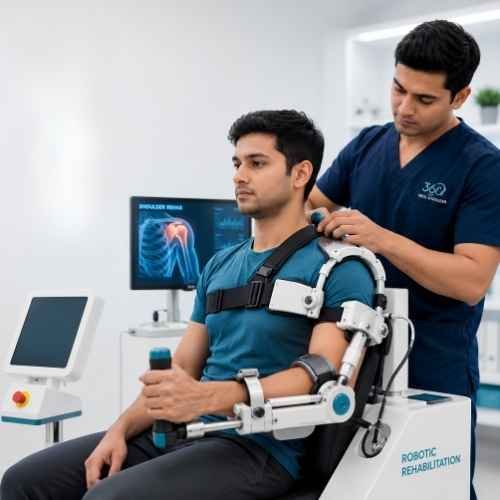
Our TECAR system's Resistive mode concentrates radiofrequency energy precisely within the high-resistance rotator cuff tendon tissue — generating deep endogenous heat that increases tendon blood flow (tendons are inherently poorly vascularised, which is why they heal slowly), stimulates fibroblast-mediated collagen synthesis, and reduces chronic tendinous inflammation at depths that surface treatments, ultrasound, or topical agents cannot reach. Combined with our robotic shoulder re-training system, this is Noida's most advanced tendon physiotherapy protocol.
Healing Protocol
Our Heal–Activate–Load
Three-Stage Rotator Cuff Rehabilitation Protocol
Effective rotator cuff physiotherapy in Noida requires all three stages in the correct sequence. Strengthening a still-inflamed tendon provokes pain and worsens the injury. Loading before the deep stabilizers are properly activated places abnormal stress on the healing tissue. And both are wasted if the biomechanical drivers of impingement are not corrected permanently.
Stage 1 — Heal: TECAR Tendon Therapy and Inflammation Resolution (Sessions 1–8)
The foundation of our rotator cuff physiotherapy protocol. TECAR therapy's Resistive mode applies deep radiofrequency energy directly into the damaged rotator cuff tendon — the most important step in accelerating biological repair of a structure that has inherently poor blood supply and therefore heals slowly without intervention. The deep endogenous heat generated dramatically increases tendon vascularity, stimulates fibroblast activity for new collagen synthesis, and reduces the chronic inflammatory mediators that perpetuate pain. Subacromial bursa inflammation is simultaneously addressed with the Capacitive mode. Most patients — even those with partial tears — report meaningful reduction in night pain and resting ache within the first four to six physiotherapy sessions in Noida. Manual soft tissue therapy releases the secondary muscle tightening of the posterior capsule and pectoralis minor that impairs shoulder mechanics during this phase.
Stage 2 — Activate: Rotator Cuff Neuromuscular Re-Education (Sessions 8–16)
Once the tendon's acute inflammatory burden has reduced, the focus shifts to restoring the precise rotator cuff activation pattern that was disrupted by pain inhibition and injury. This is the stage most commonly rushed or skipped in generic physiotherapy — but it is where the real structural protection of the recovering tendon is established. Our physiotherapists in Noida use a precise sequence of rotator cuff isolation exercises, progressing from pain-free isometric contraction through to controlled dynamic loading, re-establishing the humeral head centration that prevents repeated subacromial impingement. Scapular stabilization training — targeting the lower trapezius, serratus anterior, and rhomboids — restores the normal scapular rhythm that is consistently disrupted in shoulder injuries and essential for pain-free overhead movement.
Stage 3 — Load: Progressive Functional Strengthening and Return to Activity (Sessions 16–24)
The final stage progressively loads the healed rotator cuff tendons through the full range of functional demands — overhead lifting, carrying, throwing, and sport-specific movements — building the strength, endurance, and coordination needed for confident return to the patient's daily, occupational, and recreational activities. Specific exercises address the posterior rotator cuff (infraspinatus and teres minor), which is consistently undertrained in conventional programmes but critical for shoulder stability and protection against re-injury. Biomechanical corrections for work and sport activities — lifting technique, throwing mechanics, overhead working posture — are provided to prevent recurrence, which is the most common reason patients return to our physiotherapy clinic in Noida with the same shoulder problem.
Patient Questions