
Supraspinatus Tendinitis
Treatment in Noida
That sharp, catching pain when you lift your arm — especially between waist and shoulder height — that wakes you at night and makes reaching a shelf feel like a task: that is almost certainly your supraspinatus tendon. The most commonly injured shoulder tendon, and one of the most reliably treatable. Get the most advanced supraspinatus tendinitis physiotherapy in Noida and Greater Noida West — TECAR deep tendon healing, precise shoulder rehabilitation, and lasting results without steroid dependency.



Recognize the Signs of Supraspinatus Tendinitis
Supraspinatus Tendinitis:
The Shoulder's Most Common Tendon Problem — Explained
If you have been told you have "shoulder impingement," "rotator cuff tendinitis," or "subacromial pain syndrome," there is a very high probability that your supraspinatus tendon is the specific structure involved. The supraspinatus is the most superior of the four rotator cuff tendons, and it occupies what is anatomically the most vulnerable position in the shoulder — a narrow passage between the top of the humerus (humeral head) and the bony arch of the acromion above, called the subacromial space.
Every time you lift your arm, this tendon passes through this passage. When the passage is adequately wide and the tendon is healthy, this happens painlessly thousands of times a day. When the passage narrows — due to postural changes, muscle imbalance, bone spur formation, or tendon swelling from overuse — the tendon is compressed against the undersurface of the acromion. Repeated compression produces inflammation within the tendon (tendinitis), and inflammation produces swelling, which further reduces the subacromial space, which produces more compression — a cycle that feeds itself.
This is why supraspinatus tendinitis so often becomes chronic. The pain may settle with rest or a steroid injection, but the underlying reduction in subacromial space — from rounded shoulders, tight anterior chest muscles, weakened rotator cuff and scapular stabilizers — remains entirely unchanged. When loading resumes, the compression cycle resumes, and the tendinitis returns. Patients across Noida, Greater Noida West, Noida Extension, and the broader NCR region arrive at our clinic having been through this cycle multiple times, often over years, before seeking structured physiotherapy treatment.
At 360 Neck Shoulder Advanced Rehabilitation Centre, located at Sector 73 Noida — conveniently accessible from both Noida and Greater Noida West — our approach to supraspinatus tendinitis is built on resolving this cycle at its source: reduce the active tendinous inflammation with TECAR deep tendon therapy, restore the subacromial space by correcting the posture and muscle imbalances that narrowed it, and rebuild the rotator cuff strength that keeps it open under load.
Root Causes & Risk Factors
Why Supraspinatus Tendinitis Develops:
Desk Posture, Muscle Imbalance, and the Noida–Greater Noida West Connection
Supraspinatus tendinitis is rarely caused by a single injury. It develops from the gradual accumulation of mechanical loading in a compromised subacromial environment — a pattern directly linked to the working and lifestyle habits of Noida and Greater Noida West's rapidly growing professional population.
- Postural Subacromial Narrowing from Desk Work: The standard seated working posture across Noida's IT corridors — Sectors 62, 63, 125, 132, and across the Expressway into Greater Noida West sectors 1, 2, 4, 10, and Tech Zone — progressively rounds the thoracic spine and protracts the shoulder blades. This forward shoulder position rotates the glenoid socket downward and reduces the subacromial space from above. The result: the supraspinatus tendon is compressed even during normal arm movements that would be completely painless in a well-aligned posture. Thousands of professionals commuting daily from Gaur City, Mahagun Moderne, Supertech Eco Village, and Crossings Republik to Noida offices are unknowingly accumulating this structural narrowing every working day.
- Scapular Dyskinesia and Impaired Shoulder Blade Control: The scapula must rotate upward in a precise, coordinated pattern as the arm elevates — this upward rotation widens the subacromial passage and clears the acromion from the tendon's path. When the scapular stabilizing muscles (lower trapezius, serratus anterior) are weak or inhibited — as they consistently are in desk workers with rounded shoulders — this upward rotation is reduced, and the supraspinatus is compressed throughout the lifting arc rather than only at its peak.
- Rotator Cuff Weakness and Humeral Head Migration: The rotator cuff compresses the humeral head into the glenoid socket during arm elevation, keeping the ball centred. When the rotator cuff — particularly the infraspinatus and subscapularis — is weak, the humeral head migrates upward during lifting, directly compressing the supraspinatus tendon against the acromion. This superior migration is the most direct mechanical cause of supraspinatus impingement and tendinitis.
- Cumulative Overhead Loading in Occupations and Sport: Construction workers, painters, carpenters, and overhead sport athletes — cricket bowlers, swimmers, badminton players — all place sustained repetitive compressive load on the supraspinatus tendon. Given the dense residential and commercial construction activity across Greater Noida West, and the large number of active sports enthusiasts in the region, this occupational and athletic subgroup represents a significant proportion of supraspinatus tendinitis presentations at our clinic.
TECAR Resistive Mode — Direct Supraspinatus Tendon Therapy
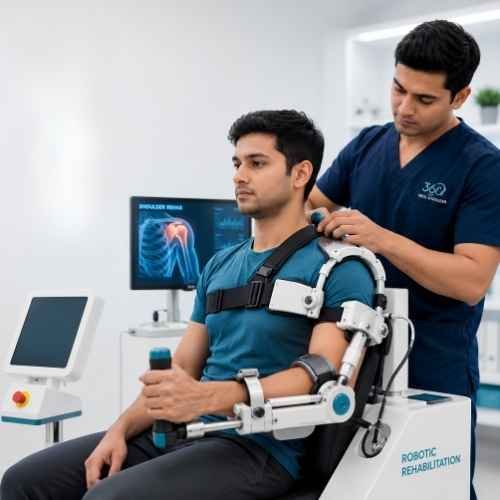
The supraspinatus tendon is inherently poorly vascularised — tendons have limited blood supply, which is why tendinitis heals so slowly without targeted intervention. Our TECAR system's Resistive mode concentrates radiofrequency energy directly within the high-resistance tendon tissue, generating deep endogenous heat that dramatically increases local tendon vascularity, stimulates fibroblast-mediated collagen synthesis, and clears inflammatory mediators — delivering biological repair to the tendon core that no surface treatment, injection, or oral medication can physically achieve.
Core Healing
Our Decompress–Heal–Stabilise
Three-Stage Supraspinatus Physiotherapy Protocol
Our supraspinatus tendinitis protocol at 360 Neck Shoulder — serving patients from across Noida, Greater Noida West, Noida Extension, and the broader NCR — is designed to break the impingement-inflammation-compression cycle at every point simultaneously.
Stage 1 — Decompress & Heal: Subacromial Unloading and TECAR Tendon Therapy (Sessions 1–8)
The first priority is reducing the active tendinous inflammation that is perpetuating the pain cycle. TECAR Resistive mode therapy is applied directly over the supraspinatus tendon and subacromial bursa, penetrating to the tendon core to stimulate biological healing — addressing the tissue damage that rest and oral anti-inflammatories leave untreated. Simultaneously, our physiotherapists apply manual posterior capsule stretching and pectoralis minor release to begin restoring the subacromial space, and provide precise activity modification guidance so the patient continues daily activities without re-compressing the inflamed tendon during treatment. Most patients notice meaningful reduction in the painful arc and night pain within the first four to six sessions.
Stage 2 — Activate: Scapular Control and Rotator Cuff Neuromuscular Restoration (Sessions 8–16)
The structural causes of subacromial narrowing — impaired scapular upward rotation and reduced humeral head centration — are the focus of this stage. Progressive scapular stabilization exercises systematically rebuild lower trapezius, serratus anterior, and rhomboid strength, restoring the scapula's ability to rotate upward correctly during arm elevation and widen the subacromial space dynamically. Rotator cuff activation training — with particular emphasis on infraspinatus and subscapularis, which are the primary humeral head depressors — re-establishes normal shoulder joint mechanics and removes the superior migration that was compressing the tendon. This is the stage that determines whether the improvement from Stage 1 is permanent or temporary.
Stage 3 — Stabilise: Postural Correction and Return to Full Activity (Sessions 16–22)
The final stage permanently corrects the postural drivers that narrowed the subacromial space in the first place. For the large number of desk workers we treat from Noida and Greater Noida West — many commuting from Gaur City, Noida Extension, Crossings Republik, and surrounding areas — this means specific ergonomic corrections to monitor height, chair configuration, and keyboard placement, combined with thoracic mobility exercises and a targeted daily postural maintenance programme. For athletic patients — cricketers, swimmers, badminton players — sport-specific overhead mechanics are analysed and corrected to distribute load safely across the rehabilitated shoulder. This stage also establishes the long-term home programme that keeps the supraspinatus protected well after formal physiotherapy treatment in Noida is complete.
Patient Questions