
Shoulder Subluxation
& Instability Treatment in Noida
That feeling of the shoulder slipping, catching, or nearly coming out — during overhead movements, throwing, or reaching — is shoulder subluxation: partial displacement of the humeral head from its socket. Alarming when it happens, but in most cases entirely manageable without surgery. The shoulder is the most mobile joint in the body and depends on its muscles and neuromuscular control for stability — which means targeted physiotherapy in Noida and Greater Noida West that rebuilds that control can restore full, confident shoulder function in the majority of patients.




Recognize the Signs of Shoulder Subluxation
Shoulder Subluxation:
Why the Shoulder Slips — and How Dynamic Stability Resolves It
The glenohumeral joint — the ball-and-socket joint of the shoulder — is the most mobile joint in the human body, with a range of motion that far exceeds any other joint. This extraordinary mobility comes at a cost: the glenoid socket is relatively shallow, and the ball of the joint is held in place primarily by soft tissue structures rather than bony architecture. The stability of the shoulder therefore depends critically on the quality of its passive stabilizers — the labrum, capsule, and ligaments — and its dynamic stabilizers — the rotator cuff muscles and the neuromuscular control system that coordinates their protective responses.
Shoulder subluxation occurs when these stabilizing structures are insufficient — most commonly after a traumatic episode that stretches or tears the anterior capsule and labrum, or in individuals with generalized joint hypermobility where the passive restraints are constitutionally lax. The humeral head partially leaves the glenoid socket — the ball slips partially out — producing the characteristic sensation of the shoulder giving way, catching, or feeling loose. Unlike full dislocation, the humeral head returns spontaneously without requiring reduction. However, repeated subluxation episodes cause progressive damage to the labrum and capsule, and the threshold for subluxation decreases with each episode — making early physiotherapy intervention critical to prevent progressive instability.
The most important clinical insight for shoulder subluxation is that the passive stabilizers that have been stretched or torn cannot be restored by physiotherapy — but in the majority of cases this does not matter, because the rotator cuff and neuromuscular system can provide sufficient dynamic stability to prevent recurrent subluxation even in the presence of capsular laxity. This is the evidence base for physiotherapy as first-line treatment: rebuilding the dynamic stabilization system that compensates for passive insufficiency. It is also why the specific exercises chosen and the neuromuscular quality of the training matter enormously — generic strengthening is insufficient; precision rotator cuff neuromuscular retraining is what produces durable stability.
At 360 Neck Shoulder Advanced Rehabilitation Centre, Sector 73 Noida — serving patients from Noida and Greater Noida West — our shoulder subluxation physiotherapy protocol systematically rebuilds dynamic glenohumeral stability through precise rotator cuff retraining, proprioceptive rehabilitation, and scapular stabilization — restoring confident shoulder function without surgery in the majority of patients.
Types & Causes
Types of Shoulder Subluxation:
Traumatic, Atraumatic, and Sport-Related Instability in Noida
Shoulder subluxation presents in several distinct patterns, each with different structural profiles and rehabilitation requirements.
- Traumatic Anterior Subluxation (Most Common): Caused by a fall on an outstretched arm, a direct impact, or a forced external rotation event — most commonly in cricket, badminton, kabaddi, and gym training across Noida and Greater Noida West. The anterior capsule and labrum are stretched or torn during the initial episode. The shoulder feels unstable in the late-cocking position of throwing or any externally rotated overhead position. Young athletes from across Noida's Sectors and Greater Noida West's active communities — Gaur City, Mahagun Moderne, Supertech Eco Village, Crossings Republik — are the highest-risk group for this presentation.
- Atraumatic Multidirectional Instability (MDI): Occurs in individuals with generalized joint laxity — often presenting as bilateral shoulder looseness without any specific injury event. MDI produces a feeling of looseness in multiple directions and responds well to intensive rotator cuff and scapular strengthening and proprioceptive training. Surgery has a high recurrence rate for MDI and physiotherapy is the strongly preferred first-line treatment.
- Posterior Subluxation: Less common than anterior instability, posterior subluxation produces discomfort and instability when the arm is in forward flexion and internal rotation — common in pushing and pressing activities, weight training with heavy bench press, and occupational pushing tasks.
- Stroke-Related and Neurological Subluxation: Inferior subluxation of the humeral head is a complication of hemiplegia after stroke, caused by loss of the muscle tone that normally maintains the humeral head in the socket. Targeted physiotherapy and support positioning are essential components of neurological shoulder rehabilitation in this group.
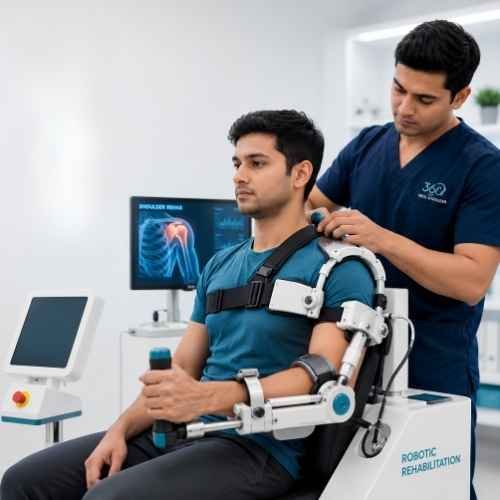
Robotic Shoulder Neuromuscular Retraining — Precision Dynamic Stabilization
Our robotic shoulder rehabilitation system delivers computer-guided, tension-monitored resistance training in precise movement patterns that specifically target the rotator cuff's dynamic stabilization function — the humeral head compression and joint centration that compensates for passive ligamentous laxity. Unlike conventional free-weight exercises that cannot guarantee correct rotator cuff activation patterns, robotic-guided retraining ensures the right muscles are being trained in the right sequence at the right resistance for dynamic stability development.
Stability Training
Our Protect–Stabilise–Perform
Three-Stage Shoulder Subluxation Physiotherapy Protocol
Our shoulder subluxation protocol at 360 Neck Shoulder — serving patients from Noida and Greater Noida West at Sector 73 — progresses from protecting the acutely injured shoulder, through systematic dynamic stability rebuilding, to confident return to sport and full activity demands.
Stage 1 — Protect: Acute Management and Initial Stability (Weeks 1–6)
In the acute post-subluxation period, the priority is protecting the injured capsule and labrum while preventing the muscle wasting and proprioceptive loss that occur rapidly with complete immobilization. Sling use is guided by injury severity and symptom response. Isometric rotator cuff activation exercises are introduced early — maintaining muscle tone and initiating the neuromuscular retraining pathway without stressing the healing capsuloligamentous structures. TECAR Capacitive mode reduces post-traumatic inflammation in the joint and surrounding soft tissues. Patient education about provocative positions to avoid — overhead and externally rotated positions for anterior instability — prevents inadvertent re-injury during the early healing phase.
Stage 2 — Stabilise: Rotator Cuff Retraining and Proprioceptive Rehabilitation (Weeks 6–18)
The core of the rehabilitation programme. Progressive rotator cuff strengthening — specifically targeting the subscapularis for anterior instability and the infraspinatus and teres minor for posterior instability — rebuilds the dynamic stabilization capacity that keeps the humeral head centred against apprehension-provoking forces. Proprioceptive rehabilitation — using balance board training, ball-wall stabilization exercises, and perturbation training — restores the joint position sense and rapid protective muscle response that are disrupted after subluxation. Scapular stabilization training ensures the scapula provides the correct stable base for the dynamic stabilizers to work from. Our physiotherapists at 360 Neck Shoulder Noida advance exercises progressively through the previously provocative range, building confidence and neuromuscular control simultaneously.
Stage 3 — Perform: Sport-Specific Loading and Return to Full Activity (Weeks 18–28)
The final stage progressively loads the rehabilitated shoulder through the specific demands of the patient's sport or occupation — throwing mechanics for cricketers, overhead stroke patterns for badminton and tennis players, pressing and Olympic lifting techniques for gym athletes, and specific reach and load patterns for manual workers. Return-to-sport criteria — strength symmetry testing, provocation test clearance, and functional confidence assessment — are applied rigorously before full sport return is approved. For patients from Greater Noida West, Gaur City, Noida Extension, and Crossings Republik returning to cricket, swimming, or other shoulder-demanding sports, sport-specific biomechanics analysis and correction prevents recurrence at the return to play stage.
Patient Questions