
Mechanical Neck Pain
Treatment in Noida
Neck pain that gets worse when you look down at your phone, builds steadily through a long day at the desk, or grips you after driving for an hour — that is mechanical neck pain: pain driven by how your cervical joints, muscles, and posture interact under load. It is the most common type of neck pain, and it is also one of the most reliably treatable — with the right combination of joint mobilization, targeted muscle work, and postural correction.




Recognize the Signs of Mechanical Neck Pain
Mechanical Neck Pain:
The Most Common Neck Condition — and the Most Undertreated
When most people say their neck hurts, what they are describing is mechanical neck pain — and yet this is the condition most commonly dismissed with a prescription for painkillers and an instruction to "rest and see how it goes." The result is a cycle many patients know all too well: the pain settles after a few days, they return to their normal work and lifestyle, and within weeks the same pain is back in the same place, slightly worse each time.
Mechanical neck pain is defined by a clear relationship between pain and mechanical loading. The pain is provoked by specific postures, movements, or sustained positions — looking down at a phone, holding the neck in a fixed position while typing, tilting the head to speak on a phone, or driving for more than thirty minutes. It eases with rest, heat, or a position change. This is the opposite of inflammatory neck pain, which is characteristically worse after rest and improves with movement, and different from neurological neck pain, which radiates down the arm in a specific nerve pattern.
The source of the pain lies in the three main mechanical structures of the cervical spine: the facet joints — the small paired joints at the back of each vertebral level that guide and limit neck movement; the intervertebral discs — the cushioning structures between the vertebral bodies that absorb compressive load; and the paraspinal muscles and ligaments — the active and passive support system that controls and stabilizes every neck movement. When any of these structures are overloaded, repeatedly compressed, strained, or restricted, they generate pain that is directly linked to how the neck is being positioned and used.
The important clinical point is that mechanical neck pain is not something patients simply have to live with. It is a biomechanical problem with identifiable drivers — specific joint restrictions, muscular imbalances, postural patterns, and ergonomic exposures — that can be systematically identified and corrected. At 360 Neck Shoulder Advanced Rehabilitation Centre, our approach to mechanical neck pain starts from this principle: find exactly which joints are restricted, which muscles are overloaded, and which daily habits are driving the mechanical loading pattern — then address all three simultaneously for lasting resolution rather than temporary relief.
Root Causes & Risk Factors
What Drives Mechanical Neck Pain:
From Facet Joint Irritation to Daily Loading Habits
Mechanical neck pain rarely has a single isolated cause. It develops from a combination of structural restrictions, muscular factors, and accumulated daily loading patterns that together overload the cervical spine's capacity to self-regulate.
- Cervical Facet Joint Dysfunction: The facet joints at each cervical level are the most common source of mechanical neck pain. They become irritated and restricted through cumulative mechanical loading — sustained postures, repeated movements at the end of range, or acute overload events such as a sudden jerk or sleeping position. Restricted facet joints produce local pain, referral into the shoulder and upper back, and protective muscle guarding that compounds the original restriction. Joint mobilization is the most effective intervention for facet-driven mechanical pain, but many patients receive only muscle-focused treatment, which provides temporary relief without addressing the underlying joint restriction.
- Intervertebral Disc Loading: The cervical discs absorb compressive and shear forces during every movement and position. Sustained forward head posture increases the compressive load on the anterior disc by up to five times compared to neutral. Over months and years, this cumulative loading produces disc dehydration, reduced height, and increased sensitivity — producing an aching pain that builds progressively through the day with sustained flexion activities like screen work and reading. Unlike a herniated disc that compresses a nerve root, discogenic mechanical pain stays in the neck and upper shoulder region and is clearly position-dependent.
- Paraspinal Muscle Overload and Trigger Points: The cervical muscles work continuously to stabilize and move the head, and they develop trigger points — hyperirritable nodules — when held in sustained low-level contraction without adequate recovery. These trigger points produce local neck pain and refer pain into the head, shoulder, and upper back. They do not resolve with passive rest alone; they require specific manual trigger point work and correction of the sustained loading pattern that maintains them.
- Postural Loading from 'Tech Neck': Sustained forward head posture during laptop, desktop, and smartphone use is now the single most common driver of mechanical neck pain in Noida's working population. Every degree of forward head inclination increases the effective load on the cervical spine — at 30 degrees of forward tilt, the cervical spine bears the equivalent of approximately 18 kg of load rather than the 5 kg it bears in neutral. Sustained over an 8–10 hour working day, this accumulated overload is the primary mechanical driver behind Noida's growing burden of occupational neck pain.
TECAR Deep Joint & Soft Tissue Therapy with Robotic Mobilization
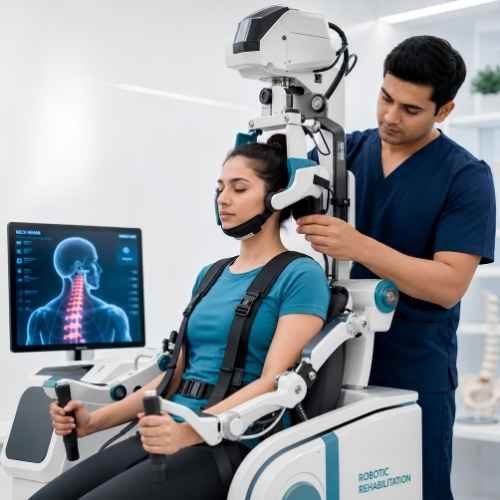
Our TECAR system delivers targeted radiofrequency energy to the irritated cervical facet joint capsules and surrounding paraspinal soft tissues — reducing joint inflammation, releasing muscle guarding, and restoring joint circulation at depths no surface treatment can reach. This is combined with our computer-guided robotic mobilization system, which delivers precise, tension-monitored joint mobilization at each restricted cervical level — restoring normal arthrokinematics and eliminating the protective muscle guarding that perpetuates the pain cycle.
Mechanical Relief
Our Find–Fix–Fortify
Three-Stage Mechanical Pain Protocol
Lasting resolution of mechanical neck pain requires all three stages. Finding the pain source without fixing the muscle balance and postural habits guarantees recurrence. And fixing the acute episode without fortifying the cervical stability means the next loading event produces the same pain again.
Stage 1 — Find & Fix: Source Identification and Acute Pain Resolution (Sessions 1–6)
The first priority is accurate clinical mapping: identifying which cervical facet joints are restricted and pain-generating, which muscle groups are overloaded and harbouring active trigger points, and what the primary postural loading pattern looks like for this patient's specific work and lifestyle. Once the mechanical source is identified, we apply TECAR therapy to the irritated joint capsule and surrounding muscles — reducing joint inflammation, releasing trigger points, and restoring circulation to the overloaded tissues. Manual cervical mobilization addresses the specific restricted joint levels, restoring normal joint play and immediately reducing protective muscle guarding. Most patients report meaningful improvement in pain levels and neck movement freedom within the first two to three sessions.
Stage 2 — Rebuild: Deep Cervical Stabilizer Strengthening (Sessions 6–14)
Restoring pain-free movement is only the beginning. The cervical spine's deep stabilizing muscles — the deep cervical flexors (longus colli and longus capitis) and the cervical multifidus — are consistently inhibited in patients with mechanical neck pain, even between pain episodes. Without rebuilding this deep stability system, the superficial muscles compensate and continue to overload, and the facet joints remain vulnerable to re-irritation with the next sustained postural challenge. This stage uses progressive deep cervical flexor retraining, cervical motor control exercises, and scapular stabilization work to rebuild the neuromuscular support system that protects the cervical spine under the daily loads it faces.
Stage 3 — Fortify: Postural Correction and Recurrence Prevention (Sessions 14–20)
The stage that determines whether this is the last episode or just the latest in a long series. We work with each patient to identify and specifically correct the daily mechanical exposures driving their neck pain: monitor and chair configuration, laptop elevation, keyboard distance, smartphone holding position, sleeping posture, and car seat and headrest setup. A progressive cervical endurance programme — designed specifically to match the patient's daily activity demands — is established and advanced to the point where the cervical spine can tolerate a full working day without accumulating the joint irritation and muscle fatigue that previously produced pain. Without this stage, we are treating the patient's last episode, not their last one.
Patient Questions