
Infraspinatus Tendinitis
Treatment in Noida
That deep, aching pain at the back of the shoulder — worse when rotating the arm outward, reaching behind your back, or lying on that side at night — is very likely your infraspinatus tendon. As the shoulder's primary external rotator, it is one of the most functionally critical and most undertreated tendons in the rotator cuff. Get the most advanced infraspinatus tendinitis physiotherapy in Noida and Greater Noida West — TECAR deep tendon healing, precise external rotator retraining, and lasting results without steroid dependency.



Recognize the Signs of Infraspinatus Tendinitis
Infraspinatus Tendinitis:
The Posterior Shoulder Tendon Most Often Missed
When patients describe deep, aching pain at the back of the shoulder — pain that worsens when rotating the arm outward, reaching across the body, or lying on that side at night — the infraspinatus tendon is almost always involved. Yet infraspinatus tendinitis remains consistently under-diagnosed, frequently because its referred pain pattern — down the front of the shoulder and arm — is mistaken for cervical nerve root problems or even carpal tunnel syndrome. Many patients from across Noida and Greater Noida West arrive at our clinic having been through multiple diagnoses and treatments that completely missed the posterior shoulder.
The infraspinatus is the primary external rotator of the shoulder, originating from the posterior surface of the scapula and inserting into the greater tubercle of the humerus. It performs external rotation of the arm and acts as a critical humeral head centrator — pressing the ball of the shoulder joint into the socket during every arm movement. Without adequate infraspinatus function, the humeral head translates forward and upward under load, stressing the anterior capsule and supraspinatus — which is why infraspinatus weakness frequently underlies supraspinatus tendinitis and shoulder impingement as well.
Inflammation develops most commonly from repetitive overload in a forward-rotated shoulder position — the standard desk, laptop, and driving posture that keeps the arm in sustained internal rotation, placing the infraspinatus under continuous eccentric load. The dense professional and commuter population of Noida, Greater Noida West, Noida Extension, and surrounding NCR areas increasingly presents with this pattern — professionals from Gaur City, Mahagun Moderne, Supertech Eco Village, and Crossings Republik commuting daily to Noida's IT and commercial hubs.
At 360 Neck Shoulder Advanced Rehabilitation Centre, Sector 73 Noida — on the main corridor connecting Noida and Greater Noida West — our infraspinatus tendinitis physiotherapy protocol combines TECAR deep posterior tendon therapy, manual posterior capsule release, and systematic external rotator and scapular strengthening that addresses the root cause of tendon overload.
Root Causes & Risk Factors
What Causes Infraspinatus Tendinitis:
Internal Rotation Overload Across Noida and Greater Noida West
Infraspinatus tendinitis develops from sustained postural overload and chronic neglect of the posterior rotator cuff — a pattern prevalent across the Noida and Greater Noida West working population.
- Sustained Internal Rotation During Desk Work and Commuting: Standard seated work posture keeps the arm in internal rotation and the shoulder blade protracted forward for hours. Long driving commutes from Greater Noida West, Gaur City, Mahagun Moderne, and Crossings Republik to Noida's Sectors 62, 63, 125, and 132 keep the infraspinatus under low-level eccentric tension daily — gradually producing cumulative tendon microtrauma.
- Posterior Rotator Cuff Neglect in Exercise: Most gym programmes focus heavily on pressing movements while neglecting external rotators, creating a muscular imbalance — strong internal rotators, weak external rotators — that overloads the infraspinatus during outward rotation and overhead stability demands.
- Infraspinatus Trigger Points and Referred Pain: Well-documented trigger points within the infraspinatus muscle refer pain to the anterior shoulder, down the arm, and sometimes into the hand. These are typically missed in routine assessment, leading to persistent pain despite treatment that ignores the posterior shoulder entirely.
- Overhead Sports in Noida and Greater Noida West: Cricket bowlers, swimmers, badminton and tennis players place high eccentric demands on the infraspinatus during the deceleration phase of throwing and overhead strokes — a primary mechanism for sports-related infraspinatus tendinitis in the active communities across the region.
TECAR Resistive Mode — Posterior Rotator Cuff Deep Tendon Therapy
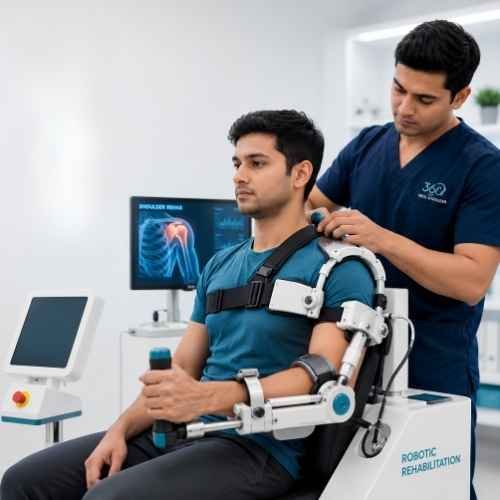
Our TECAR Resistive mode concentrates radiofrequency energy directly within the infraspinatus tendon at its greater tubercle insertion — generating deep endogenous heat that increases tendon vascularity, stimulates collagen repair, and clears inflammatory mediators. Combined with Capacitive mode to release the posterior capsule and infraspinatus trigger points, this is the most targeted posterior shoulder physiotherapy available in Noida and Greater Noida West.
Deep Healing
Our Release–Strengthen–Rotate
Three-Stage Infraspinatus Physiotherapy Protocol
Our infraspinatus tendinitis protocol at 360 Neck Shoulder — serving patients from Noida and Greater Noida West via Sector 73 — targets the posterior shoulder comprehensively, addressing the tendon, the muscle trigger points, and the underlying external rotator weakness in the correct biological sequence.
Stage 1 — Release: TECAR Tendon Therapy and Trigger Point Deactivation (Sessions 1–8)
TECAR Resistive mode is applied directly to the infraspinatus tendon to reduce tendinous inflammation and stimulate biological healing in the avascular tendon core. Skilled manual trigger point release deactivates the active trigger points within the infraspinatus belly that generate referred pain down the arm — addressing the symptom that most confuses the clinical picture. Posterior capsule stretching is introduced progressively to restore glenohumeral mobility. Most patients notice meaningful reduction in posterior shoulder pain and referred arm symptoms within the first four to six physiotherapy sessions at our Noida clinic.
Stage 2 — Strengthen: External Rotator and Scapular Stabilization (Sessions 8–16)
Progressive external rotator strengthening — beginning with side-lying external rotation and advancing through resistance band and functional loading — rebuilds infraspinatus and teres minor strength depleted by chronic overload and pain inhibition. Scapular stabilization training corrects the protracted shoulder blade position that placed the infraspinatus under chronic eccentric tension. Our physiotherapists at 360 Neck Shoulder Noida calibrate progressive loading precisely to the tendon's healing stage, ensuring optimal recovery without re-irritation throughout this phase.
Stage 3 — Integrate: Functional Movement and Long-Term Protection (Sessions 16–22)
The final stage integrates rebuilt external rotator strength into functional movements — reaching, lifting, overhead tasks, and sport-specific mechanics. Ergonomic corrections for desk work, driving, and sleep positions eliminate the sustained internal rotation posture that originally overloaded the tendon. For patients commuting from Greater Noida West, Gaur City, Noida Extension, and surrounding areas, specific driving posture guidance is provided. A structured home maintenance programme ensures lasting results well after formal physiotherapy treatment in Noida is complete.
Patient Questions