
Whiplash Injury
Treatment in Noida
Had an accident and your neck feels stiff, painful, or your head is pounding? Don't wait for it to get worse. Whiplash symptoms often appear hours or days after the impact — and the first two weeks are the most important window for preventing chronic pain. Get Noida's most experienced whiplash assessment and evidence-based rehabilitation, designed to get you recovering fast and protect your long-term function.




Recognize the Signs of Whiplash Injury
Whiplash Injury:
What Actually Happens Inside the Neck During Impact
The word "whiplash" is familiar to most people, but very few understand what actually happens to the cervical spine in the milliseconds of an accident — and why symptoms can appear to be fine immediately after, only to worsen significantly over the following days. Understanding this helps patients make two critical decisions correctly: when to seek emergency care, and why starting physiotherapy early matters so much.
During a rear-end collision — the most common cause — the torso is driven forward by the car seat while the head briefly lags behind, forcing the cervical spine into a sudden, violent hyperextension. A fraction of a second later, the head whips forward into hyperflexion as the body decelerates. This bi-phasic movement happens at speeds the voluntary muscles cannot control or protect against. The cervical structures that absorb this force are the facet joint capsules — the ligamentous tissue surrounding the small joints at the back of each vertebral level — the anterior and posterior longitudinal ligaments, the cervical discs, and the paraspinal muscles. All of these can be strained, partially torn, or compressed within this single event.
The clinical classification system for whiplash, known as Whiplash Associated Disorders (WAD), grades severity from I to IV: Grade I involves neck pain without physical signs; Grade II involves neck pain with restricted movement and local tenderness; Grade III involves neck pain with neurological signs such as arm weakness or numbness; and Grade IV involves neck pain with fracture or dislocation — requiring emergency orthopaedic management. The vast majority of whiplash presentations fall in the Grade I–III range and are the appropriate domain of physiotherapy assessment and management.
What makes whiplash clinically significant beyond the initial pain is the well-documented risk of chronic Whiplash Associated Disorder — persistent pain, headache, cognitive symptoms, and cervical dysfunction lasting more than three months. This does not develop in everyone, but research consistently shows that the single most important protective factor is early, active physiotherapy begun within the first two weeks of injury. At 360 Neck Shoulder Advanced Rehabilitation Centre, our whiplash protocol is built around this window: accurate early assessment, immediate graded treatment to prevent the cascade of stiffness and muscle inhibition that leads to chronic pain, and structured rehabilitation through to full functional recovery.
What Gets Injured & Why It Matters
Inside a Whiplash Injury:
The Structures, the Symptoms, and the Recovery Timeline
Different structures in the cervical spine produce different symptom patterns after whiplash. Understanding which structure is the primary pain generator helps explain why symptoms vary so much between patients — and why the treatment approach must be tailored to the specific injury profile.
- Cervical Facet Joint Capsule Injury (Most Common Source of Chronic Pain): Research consistently identifies the cervical facet joints — particularly C2-C3, C4-C5, and C5-C6 — as the most common source of persistent pain after whiplash. The joint capsule ligaments are stretched or partially torn during the impact, producing deep, aching, poorly localized pain in the neck and referral into the head, shoulder, and upper back. Facet joint injury also produces the characteristic stiffness and guarding that restricts neck rotation in the days following the accident. These joints respond well to graded mobilization once the acute inflammatory phase has settled.
- Cervical Ligament Strain: The anterior longitudinal ligament, posterior longitudinal ligament, and interspinous ligaments are all subjected to rapid, high-force stretch during the acceleration-deceleration event. Ligament strains produce diffuse, poorly defined pain and a sense of instability or "looseness" in the neck in the acute phase — a common and alarming symptom for patients, but one that typically resolves as ligament healing progresses over six to twelve weeks with appropriate physiotherapy support.
- Paraspinal Muscle Strain and Protective Guarding: The rapid involuntary contraction of cervical muscles attempting to protect the spine during impact can itself cause muscle strain. Combined with the protective guarding that develops over the following hours as inflammation builds, muscle-related stiffness and pain frequently dominate the early clinical picture — often masking the deeper joint and ligament injuries underneath.
- Disc Injury and Neurological Involvement (WAD Grade III): In higher-force impacts, the cervical intervertebral discs can be torn or herniated, compressing an adjacent nerve root and producing the characteristic radiculopathy pattern — sharp arm pain, numbness, or weakness in a specific distribution. This requires careful assessment and imaging to confirm before mobilization is introduced, and in some cases requires coordination with a spine specialist alongside physiotherapy.
TECAR Soft Tissue Recovery & Graded Robotic Cervical Mobilization
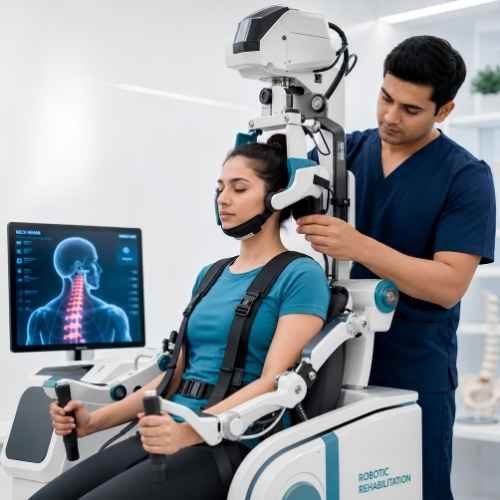
Our TECAR system delivers targeted radiofrequency energy to the injured cervical facet capsules, strained ligaments, and guarded paraspinal muscles — dramatically accelerating local tissue healing, reducing acute inflammation, and restoring circulation to injured structures without the mechanical force of manual therapy in the acute phase. As symptoms settle, our computer-guided robotic mobilization system introduces graded, tension-monitored joint movement — restoring normal arthrokinematics safely and precisely at each injured cervical level.
Fast Recovery
Our Assess–Recover–Restore
Three-Stage Whiplash Rehabilitation Protocol
Whiplash rehabilitation must match the biological phase of tissue healing at each stage. Too much too soon re-injures healing structures. Too little for too long allows stiffness, weakness, and central sensitization to establish — the pathway to chronic pain. Our protocol is timed precisely to the healing biology.
Stage 1 — Assess & Protect: Accurate Grading and Acute Symptom Management (Week 1–2)
The first priority is accurate WAD grading: identifying whether neurological signs are present (WAD III) — which requires imaging before mobilization — and ruling out any red-flag features that need emergency medical referral (severe localized bony tenderness, significant neurological deficit, or high-force mechanism suggesting fracture). For WAD I and II presentations, our first sessions combine TECAR soft tissue therapy to reduce acute inflammation, deactivate the protective muscle spasm, and support early tissue healing — all without the mechanical load of early manual joint mobilization on still-acutely-inflamed capsular tissues. Gentle, active range of motion is encouraged from day one to prevent the stiffness and muscle inhibition that accelerate chronicity. Clear patient education about the expected recovery timeline is provided in this stage — evidence shows that positive, realistic expectations are one of the strongest predictors of good recovery.
Stage 2 — Recover: Graded Mobilization and Neuromuscular Restoration (Week 2–8)
As the acute inflammatory phase resolves, graded manual and robotic cervical mobilization is introduced to restore joint mobility at the specifically restricted cervical levels, break down early capsular adhesions at the facet joints, and reintroduce normal cervical movement patterns. Simultaneously, deep cervical flexor and cervical multifidus retraining addresses the neuromuscular inhibition that consistently occurs after whiplash — the deep stabilizing muscles switch off in response to pain and injury and do not automatically switch back on when pain resolves, leaving the cervical spine vulnerable to re-injury. Upper cervical proprioceptive retraining addresses the dizziness and balance disruption common in whiplash by recalibrating the cervical positioning signals that were disrupted during the impact event.
Stage 3 — Restore: Full Functional Capacity and Chronic Pain Prevention (Week 6–16)
The stage that separates complete recovery from partial recovery. This phase progressively rebuilds cervical endurance under the full loading demands of the patient's daily life — sustained driving, desk work, overhead tasks, exercise — training the spine to tolerate these activities without accumulating pain and fatigue. Ergonomic corrections for work and driving environments are made. A structured home maintenance programme provides the progressive loading the cervical spine needs to fully remodel the healing soft tissues. Patients with persistent cognitive or vestibular symptoms from the injury receive specific rehabilitation targeting these domains. Without this stage, patients frequently feel "mostly better" but remain vulnerable to a re-exacerbation from any significant activity challenge.
Patient Questions