Acromioclavicular Arthritis
Treatment in Noida
Pain precisely at the top of the shoulder — at the bump where the collarbone meets the shoulder — that worsens when you reach across your body, press heavy in the gym, or lift overhead: this is the characteristic picture of acromioclavicular (AC) joint arthritis. A common and frequently misdiagnosed condition, often confused with rotator cuff problems or impingement. And one that responds well to targeted physiotherapy in Noida and Greater Noida West — TECAR joint therapy, shoulder girdle unloading, and long-term mechanical management — without surgery in the majority of patients.



Recognize the Signs of AC Joint Arthritis
Acromioclavicular Arthritis:
The Top-of-Shoulder Pain That's Frequently Confused With Impingement
The acromioclavicular joint — the small but mechanically significant joint at the very top of the shoulder, where the outer end of the clavicle (collarbone) articulates with the acromion process of the scapula — is one of the most commonly arthritic joints in the upper body. Yet AC joint arthritis is frequently misdiagnosed or overlooked in clinical practice, with patients treated for subacromial impingement or rotator cuff tendinitis while the actual source of their pain — sitting precisely at the top of the shoulder — goes unaddressed.
The AC joint has a fibrocartilage disc lining its articulating surfaces, and like all weight-bearing joints, this cartilage degenerates progressively with age, cumulative mechanical loading, and previous injury. Degenerative changes within the AC joint are present on imaging in the majority of people over 50, but become clinically symptomatic when the cartilage loss reaches a threshold that allows subchondral bone exposure, synovial inflammation, and osteophyte (bone spur) formation — producing the local joint pain, swelling, and restricted cross-body movement that characterises AC joint arthritis.
The most clinically distinctive features of AC joint arthritis are its precise location — pain localised exactly to the AC joint and not to the lateral or posterior shoulder — and its specific provocative movements: reaching across the body (cross-body adduction), lifting above 120 degrees of elevation where the greater tubercle contacts the AC joint undersurface, and loading the joint in compression with heavy pressing and dipping exercises. These features clearly distinguish AC joint arthritis from subacromial impingement, where the painful arc is in the 60–120 degree range, and from rotator cuff tendinitis, which produces pain throughout the lateral shoulder rather than at a precise bony landmark.
At 360 Neck Shoulder Advanced Rehabilitation Centre, Sector 73 Noida — serving patients from Noida and Greater Noida West on the main connecting corridor — our AC joint arthritis protocol combines TECAR therapy to reduce joint inflammation, targeted exercise to unload and protect the arthritic joint, and long-term postural and ergonomic correction to minimise the cumulative mechanical burden that drives symptom progression.
Causes & Risk Factors
Who Gets AC Joint Arthritis and Why:
Gym Athletes, Manual Workers, and Overhead Sports in Noida
AC joint arthritis develops from a combination of natural age-related cartilage degeneration and accumulated mechanical loading — with specific risk factors highly prevalent in the Noida and Greater Noida West population.
- Heavy Gym Training — Bench Press, Dips, Upright Rows: The AC joint is aggressively compressed during heavy bench press (particularly wide-grip), dips, upright rows, and any exercise that brings the arms into adduction under load. Gym enthusiasts across Noida and Greater Noida West — training in facilities in Sectors 62, 63, Gaur City, Mahagun, and Crossings Republik — who have trained heavy for years accumulate significant cumulative AC joint loading. This is the most common driver of early AC joint arthritis in the 30–50 age group at our physiotherapy clinic in Sector 73 Noida.
- Previous AC Joint Sprain or Dislocation: A history of AC joint injury — from a fall onto the point of the shoulder in cricket, kabaddi, cycling, or a road accident — accelerates subsequent degenerative changes in the already-damaged joint. Even Grade I and II AC joint sprains that were managed conservatively at the time can produce early arthritis within five to ten years if the joint was significantly damaged.
- Overhead Occupational Loading: Construction workers, painters, electricians, and manual workers across the rapidly developing sectors of Greater Noida West and Noida who perform sustained overhead work place cumulative compressive load on the AC joint that accelerates cartilage wear over a working career.
- Age-Related Degeneration: After the fourth decade, degenerative changes in the AC joint fibrocartilage are nearly universal on imaging. Clinical symptoms develop when degeneration reaches the threshold of subchondral bone exposure and synovial inflammation — a process whose speed is directly influenced by the cumulative mechanical loading factors above.
TECAR Capacitive Mode — Direct AC Joint Inflammation Therapy
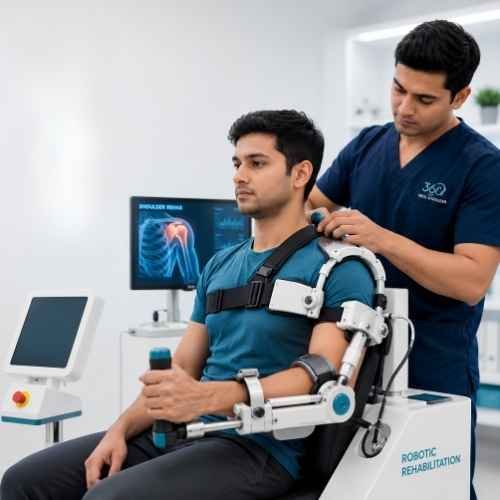
The AC joint is a small, superficial joint that is directly accessible to TECAR Capacitive mode therapy. Radiofrequency energy delivered to the arthritic joint tissue reduces synovial inflammation, improves subchondral blood flow, and reduces the periarticular soft tissue oedema that compounds joint pain. Unlike oral anti-inflammatories, which affect the entire body without reaching the joint cartilage specifically, TECAR concentrates its therapeutic effect precisely within the AC joint — producing targeted, cumulative pain reduction with each treatment session.
Direct Therapy
Our Reduce–Unload–Protect
Three-Stage AC Joint Arthritis Physiotherapy Protocol
Our AC joint arthritis protocol at 360 Neck Shoulder — serving patients from Noida and Greater Noida West at Sector 73 — manages joint inflammation, mechanically unloads the arthritic joint through targeted exercise and ergonomic correction, and builds the shoulder girdle resilience that protects the joint over the long term.
Stage 1 — Reduce: TECAR Joint Therapy and Inflammation Control (Sessions 1–8)
TECAR Capacitive mode is applied directly to the AC joint to reduce active synovial inflammation and periarticular soft tissue swelling — the primary drivers of acute AC joint pain. Precise activity modification eliminates the specific loading patterns that are acutely compressing the arthritic joint: heavy bench press, dips, upright rows, and cross-body reaching are temporarily modified or avoided. Anti-inflammatory advice — including relative rest principles, ice application protocols, and sleeping position guidance — complements TECAR therapy. Most patients at our physiotherapy clinic in Noida notice meaningful reduction in top-of-shoulder pain and cross-body discomfort within the first four to six sessions.
Stage 2 — Unload: Joint Mechanics Optimisation and Strength Rebuilding (Sessions 8–16)
The focus shifts to optimising the mechanical environment of the AC joint. Scapular stabilization training — rebuilding lower trapezius and serratus anterior strength — restores normal scapular mechanics and reduces the compressive load transmitted through the AC joint during arm elevation. Postural correction for the forward shoulder position common in desk workers from Noida and Greater Noida West reduces the chronic AC joint loading from protracted clavicular position. Progressive shoulder girdle strengthening is reintroduced using exercise selection and technique modifications that load the shoulder without aggravating the AC joint — training around the arthritis rather than through it, to maintain overall shoulder strength while protecting the damaged joint.
Stage 3 — Protect: Long-Term Management and Gym Return (Sessions 16–22)
AC joint arthritis is a degenerative condition — the structural changes cannot be reversed. The goal of this stage is to establish the long-term management strategies that minimise symptom progression and keep the joint functional for the patient's lifetime. Gym training modification guidance — replacing wide-grip bench press with narrow-grip, substituting dips with tricep pushdowns, eliminating upright rows — maintains training volume and strength without continuing to overload the arthritic joint. Ergonomic corrections for workstation, driving position, and sleeping habits reduce the cumulative daily mechanical burden. A structured home exercise and joint protection programme gives patients from Noida and Greater Noida West the tools for independent long-term management after formal physiotherapy treatment at our Noida clinic is complete.
Patient Questions