
Cervical Spondylitis
Treatment in Noida
Cervical spondylitis is an active inflammatory condition — not wear-and-tear. If your neck is most painful in the morning, stiff for over an hour, and gradually improves as you move, you need targeted anti-inflammatory rehabilitation. Get Noida's most advanced, clinically proven TECAR-based inflammation reversal protocol — without surgery or lifelong medication.




Recognize the Warning Signs of Cervical Spondylitis
Cervical Spondylitis:
When Your Spine Is on Fire — Not Just Wearing Out
Most patients who come to us have been told they have "neck degeneration" and given painkillers for years. But when your worst pain arrives before you even get out of bed — when your neck is locked and aching for over an hour every single morning, when rest makes the pain worse rather than better — that is not degeneration. That is active inflammation. And it has a very different name: Cervical Spondylitis.
The suffix "-itis" in medicine always means one thing: inflammation. Cervical Spondylitis is a condition where the body's immune system triggers a sustained inflammatory response within the cervical spine — specifically targeting the facet joint capsules, intervertebral disc borders, and paraspinal entheses (the attachment points of ligaments to bone). The result is accumulation of inflammatory mediators — prostaglandins, cytokines, interleukins — inside the cervical joint space, which causes the deep pain, swelling, and progressive stiffness that will not respond to conventional physiotherapy or painkillers alone.
This is fundamentally different from Cervical Spondylosis, which is a structural, degenerative condition. Spondylosis ("-osis" = degenerative process) involves disc desiccation, bone spur formation, and mechanical nerve compression — its pain is aggravated by activity and movement. Cervical Spondylitis is the opposite: its hallmark is inflammatory morning stiffness that improves with movement as joint circulation resumes and clears inflammatory mediators. Treating spondylitis with the same protocol as spondylosis — decompression and mobilization without clearing the inflammation first — is why so many patients see poor, short-lived results.
At 360 Neck Shoulder Advanced Rehabilitation Centre, our clinical approach is built on a clear biological principle: an inflamed joint cannot be effectively rehabilitated until the inflammation is clinically resolved. Our staged protocol eliminates the active inflammatory burden first, then systematically rebuilds cervical stability for permanent, lasting relief.
Root Causes & Risk Factors
What Triggers Cervical Spondylitis:
From Immune Pathways to Tech Neck
Cervical spondylitis arises from a complex interplay of immune dysregulation, mechanical micro-trauma, and modern lifestyle stressors — all particularly concentrated in Noida's IT and corporate workforce.
- Immune-Mediated Inflammatory Spondyloarthropathy: In a significant subset of patients, cervical spondylitis represents the spinal manifestation of systemic inflammatory disease — including Ankylosing Spondylitis (AS), Psoriatic Arthritis, or Reactive Arthritis. The HLA-B27 gene is a key genetic risk marker. The immune system mistakenly attacks the spinal entheses, triggering chronic progressive joint inflammation that can lead to vertebral fusion (ankylosis) if untreated for years.
- Facet Joint Synovitis from Chronic Postural Micro-Trauma ('Tech Neck'): Sustained forward head posture — the standard working position for IT professionals across Noida — applies up to 27 kg of compressive force on lower cervical facet joints (versus the normal 5 kg in neutral). This mechanical overload damages the synovial membrane lining of the facet joints, triggering repetitive low-grade inflammatory responses that, over months, evolve into chronic spondylitis.
- Post-Traumatic Reactive Inflammation: Whiplash injuries, sports impacts, or repetitive micro-shocks can injure the cervical joint capsule. The resulting synovial inflammation, if inadequately treated, establishes a chronic inflammatory cycle — presenting as persistent spondylitis-pattern pain months after the original injury appears healed.
- Cervical Discitis — Disc Border Inflammation: The outer annulus fibrosus of the cervical intervertebral disc is richly innervated and can develop isolated inflammation — distinct from degeneration. This produces deep, diffuse cervical pain with pronounced morning stiffness and sensitivity to sustained static loading such as prolonged driving or desk work.
TECAR Capacitive & Resistive Anti-Inflammatory System
Our specialized TECAR system penetrates 4–6 cm into the cervical joint space using dual-mode radiofrequency energy — Capacitive mode for paraspinal soft tissue and Resistive mode for the bony facet joint capsule. It flushes inflammatory cytokines, restores joint microcirculation, and achieves deep anti-inflammatory effects that no oral or topical medication can replicate at that tissue depth.
Inflammation Relief
Our Inflammation-First,
Three-Stage Clinical Protocol
Effective cervical spondylitis management requires a disciplined, sequenced clinical approach. Rushing to mobilization before the active inflammation is resolved is the single most common reason patients relapse. Our three-stage protocol is built around the biology of how inflammation resolves and joint tissue heals.
Stage 1 — TECAR Deep Anti-Inflammatory Therapy (Sessions 1–8)
The foundation of our spondylitis protocol. TECAR therapy's Resistive mode applies precise electromagnetic energy directly into the inflamed cervical facet joint capsule — the exact tissue that is pathologically inflamed in spondylitis. The biocompatible endogenous heat generated dramatically accelerates joint microcirculation, flushing out accumulated prostaglandins and inflammatory cytokines from the joint space. Simultaneously, it reduces synovial thickening and promotes fibroblast-mediated tissue repair at the entheses. Patients typically report a marked reduction in morning stiffness duration — from 2 hours to under 30 minutes — within the first 4–6 sessions.
Stage 2 — Robotic Cervical Mobilization & Joint Capsule Restoration (Sessions 8–16)
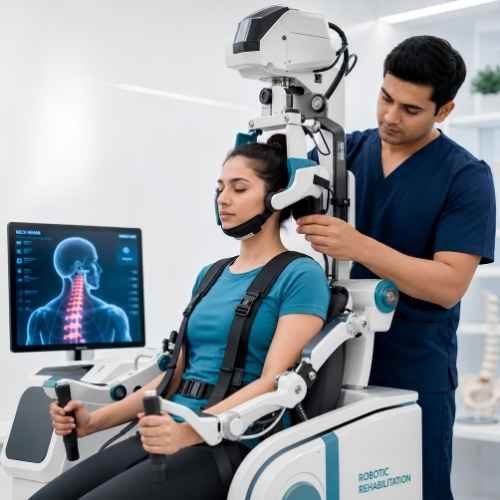
Once TECAR therapy has sufficiently reduced the acute inflammatory burden, our computer-guided robotic mobilization system is introduced. Precise, tension-monitored robotic movements restore normal arthrokinematics (joint play) to the cervical facet joints — breaking down the capsular adhesions and fibrotic tissue that form during the inflammatory phase. The robotic system's real-time biofeedback ensures every movement is within the safe tissue tolerance threshold, preventing provocation of residual inflammation. This stage restores the full, pain-free range of cervical rotation, lateral flexion, and extension that has been restricted by months of joint guarding.
Stage 3 — Neuromuscular Stabilization & Postural Re-education (Sessions 16–24)
The essential final stage — most commonly omitted in conventional clinics. This phase targets the deep cervical flexors (longus colli, longus capitis) — the primary stabilizing muscles of the cervical spine that become severely weakened during a spondylitis inflammatory episode. Systematic deep cervical flexor retraining, combined with scapular stabilization and comprehensive posture correction, permanently eliminates the 'Tech Neck' loading pattern — the very trigger that initiated the inflammatory cycle. Without this stage, successfully treated patients consistently relapse within 6–12 months.
Patient Questions