
Neck Spasm
Treatment in Noida
Woke up unable to turn your head, or felt your neck suddenly lock up with sharp, gripping pain? A neck spasm can be alarming, but it almost always responds quickly to the right hands-on treatment. Get Noida's fastest, most experienced neck spasm relief — targeted muscle release, gentle mobilization, and same-day appointments to get you moving again.




Recognize the Signs of a Neck Spasm
Neck Spasm:
When a Muscle Locks Up to Protect Itself
Most patients who come to us with this problem describe almost the exact same moment: they woke up, turned to reach for their phone, and suddenly could not move their neck at all. Or they bent down quickly, and a sharp, gripping pain locked one side of the neck instantly. This sudden, alarming loss of movement is a neck spasm — an involuntary, protective contraction of one or more neck muscles.
The mechanism is the body's own defense system working, just a little too aggressively. When a neck muscle is irritated, mildly strained, or placed under unexpected load — often from an awkward sleeping position, a sudden turn, or prolonged static posture — the nervous system triggers the muscle to contract tightly and hold that contraction, in an attempt to "splint" the area and prevent further injury. The result is a muscle that feels rock-hard to the touch, pain that is often sharp and localized to one side, and a dramatic, sudden restriction in how far you can turn or tilt your head.
The good news is that a straightforward muscular neck spasm is almost always self-limiting and highly treatable — it is the body overreacting to protect itself, not a sign of structural damage. With the right combination of targeted muscle release, gentle mobilization, and guidance on safe movement, most patients see significant relief within their very first session, and full resolution within days rather than weeks.
At 360 Neck Shoulder Advanced Rehabilitation Centre, our approach to neck spasm is built on speed and precision: get the locked muscle to release quickly and safely, restore comfortable movement, and then identify and correct whatever postural or mechanical factor triggered the spasm in the first place — so you are not back in the same position again in a few weeks.
Root Causes & Risk Factors
What Triggers a Neck Spasm:
From a Bad Night's Sleep to Chronic Tension
Neck spasm can be triggered by a single identifiable event or can build up from sustained, low-grade strain — a pattern increasingly common across Noida's desk-based working population.
- Sleeping in an Awkward Position: An unsupportive pillow, sleeping on the stomach with the neck rotated, or an unusually warm or cold night can leave a neck muscle in a shortened or stretched position for hours, triggering a protective spasm that is often first noticed immediately upon waking.
- Sudden or Jerky Movement: A quick turn to check a blind spot while reversing, an unexpected jolt during travel, or reaching awkwardly for an object can place sudden, unguarded load on a neck muscle, triggering an immediate protective contraction.
- Prolonged Static Posture and 'Tech Neck': Hours spent in a fixed forward head position during desk work, laptop use, or scrolling on a phone keeps the same neck muscles under sustained low-level tension. Eventually, these chronically fatigued muscles can spasm in response to even a minor additional trigger, which is extremely common across Noida's IT and corporate sectors.
- Stress-Related Muscle Tension: Psychological stress measurably raises baseline tension in the neck and upper trapezius muscles. Many people unconsciously hold tension in this area during high-pressure periods, and this sustained tightness can tip over into a full spasm, especially when combined with poor posture or dehydration.
TECAR Rapid Muscle Release & Manual Trigger Point Therapy
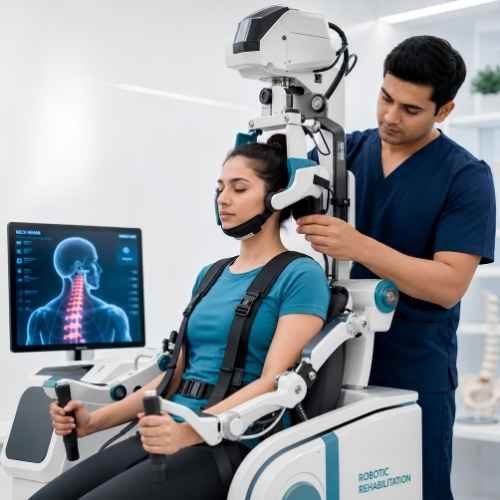
Our TECAR system applies targeted radiofrequency energy directly into the spasmed muscle, dramatically improving local circulation and helping the muscle release its protective contraction far faster than rest or heat alone. Combined with skilled manual trigger point release and gentle assisted mobilization, this approach is specifically designed to break the spasm cycle quickly, often delivering noticeable relief within the very first session.
Spasm Relief
Our Release-First,
Three-Stage Recovery Protocol
Effective neck spasm treatment requires acting quickly to break the muscle's protective contraction, then ensuring the underlying trigger does not bring the spasm straight back. Our three-stage protocol is built around this exact sequence.
Stage 1 — Rapid Spasm Release (Visit 1–2)
The priority in the first visit is immediate relief. TECAR therapy and skilled manual release techniques are applied directly to the spasmed muscle to improve circulation, reduce the protective contraction, and ease the sharp, locked sensation patients describe. Gentle, pain-free range of motion is reintroduced carefully, never forced, to avoid re-triggering the spasm. Most patients leave their first visit with a noticeably greater range of neck movement and significantly reduced pain.
Stage 2 — Restoring Full, Comfortable Movement (Visit 3–5)
Once the acute spasm has settled, treatment shifts toward fully restoring normal neck mobility and addressing any residual muscle guarding or tightness in surrounding areas, such as the upper trapezius and shoulder. Gentle mobilization and progressive stretching ensure the neck regains its complete, pain-free range of motion rather than settling into a partially restricted "new normal," which is a common reason patients feel persistently stiff even after the sharpest pain has gone.
Stage 3 — Trigger Identification & Recurrence Prevention
The stage most commonly skipped elsewhere. We work with you to identify what actually triggered this spasm — sleeping posture, desk ergonomics, stress patterns, or muscle weakness — and provide specific, practical corrections: pillow and sleep position guidance, ergonomic adjustments for desk and phone use, and targeted strengthening for the deep neck stabilizing muscles. This is the difference between resolving one spasm and preventing the next one from happening in a few weeks.
Patient Questions