
Torticollis
Treatment in Noida
Whether you have woken up with your head locked and twisted to one side, or your neck has been slowly pulling into an abnormal position over weeks and months — Torticollis demands precise diagnosis before treatment begins. Acute wry neck and chronic cervical dystonia look similar but require entirely different clinical approaches. Get Noida's most experienced torticollis assessment and targeted rehabilitation — correctly matched to your type, for lasting results.




Recognize the Signs of Torticollis
Torticollis:
One Condition Name, Several Very Different Clinical Realities
Few conditions cause as much confusion in both patients and clinicians as torticollis. The word itself — from the Latin tortus (twisted) and collum (neck) — simply describes a posture: the head tilted toward one shoulder with the chin rotated away. But that single visible presentation can result from mechanisms that are entirely different in origin, severity, and treatment. Getting the type right before beginning treatment is not a detail — it is the whole game.
The most common presentation in adults is Acute Wry Neck — a sudden, painful muscular spasm typically involving the sternocleidomastoid and the upper cervical paraspinal muscles on one side, causing the head to lock into that characteristic tilt. Most patients wake up with it after an awkward night's sleep, or feel it appear suddenly after a quick unguarded neck movement. The muscle is in protective spasm; the joint mechanics of the upper cervical spine are temporarily restricted; and with skilled, targeted treatment, the condition resolves significantly within days and fully within one to two weeks. This is a highly treatable, self-limiting condition — provided it is managed correctly and promptly.
The second presentation is Spasmodic Torticollis (Cervical Dystonia) — a neurological movement disorder in which the brain's basal ganglia send persistent, involuntary contraction signals to specific neck muscles. The resulting sustained twisting or tilting cannot be fully corrected by voluntary effort, is typically present throughout waking hours, and does not resolve with rest. Patients often notice a characteristic feature called a geste antagoniste — briefly touching the chin, jaw, or cheek temporarily reduces the involuntary pulling, which is a neurologically recognized diagnostic sign. This form requires coordinated management between neurologist and physiotherapist, and commonly involves botulinum toxin injections alongside structured rehabilitation.
At 360 Neck Shoulder Advanced Rehabilitation Centre, our starting point with every torticollis presentation is the same: precise clinical differentiation before any treatment begins. A wry neck treated as dystonia, or a dystonia treated as a simple spasm, gives poor results in both directions. With the correct type identified, our clinical pathway is built to match it exactly.
Types & Root Causes
Understanding Torticollis:
From Acute Wry Neck to Cervical Dystonia
Torticollis exists on a clinical spectrum. Knowing where on that spectrum a patient sits determines everything about the treatment approach, expected timeline, and outcome.
- Acute Wry Neck (Muscular Torticollis): The most frequently seen presentation. Sudden onset of sternocleidomastoid and cervical paraspinal spasm, usually following sleeping in a poor position, a sudden jerky movement, prolonged exposure to cold air on the neck, or mild upper cervical joint irritation. The muscle contracts protectively and holds the head in a characteristic tilt. Highly responsive to TECAR deep tissue release and gentle cervical mobilization — most patients see significant improvement within two to three sessions.
- Spasmodic Torticollis / Cervical Dystonia: A chronic neurological disorder involving abnormal, involuntary neck muscle contractions originating from dysregulated motor signals in the basal ganglia. Onset is typically gradual, the twisting posture is sustained and largely involuntary, and the condition does not resolve between episodes. Treatment requires coordination with a neurologist, often combined with periodic botulinum toxin (Botox) injections alongside specialized physiotherapy focused on sensorimotor retraining.
- Congenital Muscular Torticollis (Infants): Present from birth or developing in the first weeks of life, due to fibrosis or shortening of the sternocleidomastoid muscle on one side — often related to positioning in the womb or birth trauma. Identified by a consistent head tilt and palpable fibrous thickening in the muscle belly. Early physiotherapy with structured stretching and positioning is the treatment of choice, with excellent outcomes when started promptly in the first months of life.
- Ocular and Vestibular Torticollis: A compensatory head tilt adopted in response to an eye muscle imbalance (superior oblique palsy) or vestibular asymmetry, where tilting the head is the brain's way of reducing double vision or maintaining balance. This form requires identification and treatment of the underlying visual or vestibular cause, not just the neck posture — physiotherapy alone without addressing the root cause gives incomplete results.
TECAR Rapid Muscle Release & Cervical Sensorimotor Re-Training
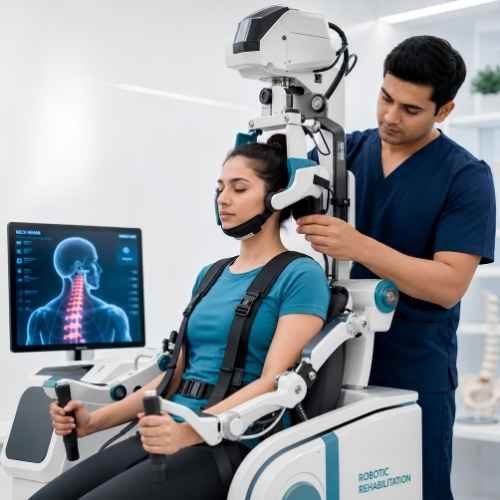
For acute wry neck, our TECAR system applies targeted radiofrequency energy directly into the contracted sternocleidomastoid and cervical muscles, breaking the protective spasm rapidly and restoring comfortable movement within the first session. For chronic cervical dystonia, we use a structured cervical sensorimotor re-training protocol — exercises designed to retrain the brain's faulty positioning signals, reduce secondary muscle overload, and improve functional neck control between botulinum toxin cycles.
Precision Protocol
Our Diagnosis-First,
Three-Stage Clinical Pathway
Because acute wry neck and cervical dystonia require different clinical approaches, our first commitment to every torticollis patient is accurate clinical differentiation — so the treatment they receive is exactly matched to what is actually causing their head position.
Stage 1 — Clinical Differentiation & Immediate Symptom Relief (Visit 1–2)
Every torticollis patient begins with a structured clinical assessment: onset pattern, whether the position is fully sustained or partially reducible, presence of a sensory trick (geste antagoniste), pain character, prior medical history, and any neurological features. For acute wry neck, treatment begins immediately — TECAR therapy is applied to the contracted sternocleidomastoid and cervical paraspinals to release the protective spasm, followed by gentle assisted mobilization of the restricted upper cervical segment and careful reintroduction of active neck movement. Most acute wry neck patients leave their first visit with measurably greater range of motion and substantially reduced pain. Where cervical dystonia is suspected, we initiate our structured physiotherapy protocol and coordinate referral to a movement disorder neurologist for confirmed diagnosis and management.
Stage 2 — Full Mobility Restoration or Sensorimotor Retraining (Sessions 3–12)
For acute wry neck: once the initial spasm has settled, this stage focuses on fully restoring normal cervical range of motion in all directions, addressing any residual guarding in the upper trapezius and scalene muscles that commonly persist after the primary sternocleidomastoid spasm has released, and preventing recurrence through postural correction and targeted cervical stabilizer strengthening. For cervical dystonia: this stage delivers structured cervical sensorimotor retraining — a protocol using mirrors, proprioceptive feedback, and carefully designed movement sequences to help the nervous system improve its awareness of neutral head position and reduce the intensity of the involuntary pulling, working in coordination with the patient's neurological management plan.
Stage 3 — Recurrence Prevention & Long-Term Self-Management
For acute wry neck, this stage identifies and corrects the underlying trigger — sleeping posture, pillow support, cervical muscle weakness, postural patterns — to prevent what is otherwise a highly recurrent condition. We provide specific pillow and sleep position guidance, ergonomic corrections for desk and screen use, and a targeted home exercise programme for the deep cervical flexors and upper cervical stabilizers. For cervical dystonia, this stage establishes the patient's ongoing maintenance programme: a structured home sensorimotor exercise routine, self-monitoring of postural patterns, and clear guidance on integrating physiotherapy effectively around their botulinum toxin injection schedule.
Patient Questions