
Scapular Dyskinesia
Treatment in Noida
Your shoulder blade moves abnormally during arm elevation — tilting, winging, or shrugging prematurely — and this faulty scapular movement pattern is the hidden driver behind your shoulder pain, impingement, or rotator cuff problem. Scapular dyskinesia is not just a diagnosis in itself — it is the underlying movement impairment present in the majority of shoulder conditions, and the one most consistently undertreated. Get the most advanced scapular motor control rehabilitation in Noida and Greater Noida West — precision scapular retraining, thoracic mobility correction, and the muscle rebalancing that resolves shoulder problems from the foundation up.




Recognize the Signs of Scapular Dyskinesia
Scapular Dyskinesia:
The Hidden Movement Impairment Behind Most Shoulder Pain
When a patient with shoulder impingement, rotator cuff tendinitis, or shoulder instability fails to improve despite apparently adequate treatment of the primary condition, the most common reason is that the scapular motor control impairment underlying their shoulder problem was never identified or addressed. Scapular dyskinesia — altered, abnormal scapular movement patterns during arm elevation — is present in the majority of shoulder pain presentations and is one of the most clinically important yet most consistently under-assessed findings in shoulder physiotherapy practice.
The scapula is not a passive bone. During arm elevation from 0 to 180 degrees, the scapula must perform a precisely choreographed three-dimensional movement sequence: rotating upward approximately 50–60 degrees, tipping posteriorly, and retracting — all timed in exact coordination with the movement of the humerus in the glenohumeral joint. This coordinated movement is called scapulohumeral rhythm, and it serves critical mechanical functions: rotating the acromion away from the supraspinatus tendon to maintain subacromial clearance, orienting the glenoid socket to remain congruent with the humeral head throughout the arc, and providing the stable proximal base from which the rotator cuff muscles generate force to elevate and stabilize the arm.
When scapular dyskinesia is present — when the scapula tips forward instead of backward, fails to rotate upward adequately, or moves asymmetrically compared to the other side — these critical mechanical functions are compromised. Subacromial space narrows and the supraspinatus is impinged. The glenohumeral joint becomes unstable as the glenoid loses its optimal orientation. The rotator cuff is mechanically disadvantaged and must work harder under every load. The entire shoulder system is built on a faulty foundation — and no amount of rotator cuff strengthening or subacromial therapy will produce lasting results until that foundation is corrected.
At 360 Neck Shoulder Advanced Rehabilitation Centre, Sector 73 Noida — serving patients from Noida and Greater Noida West — scapular dyskinesia assessment is a standard part of every shoulder evaluation. Our physiotherapy protocol for scapular dyskinesia addresses every contributing factor simultaneously: lower trapezius and serratus anterior activation, thoracic mobility restoration, pectoralis minor release, and progressive scapular motor control retraining that rebuilds the normal scapulohumeral rhythm.
Causes & Contributing Factors
What Disrupts Scapular Movement:
Muscle Imbalance, Thoracic Stiffness, and the Desk Worker's Shoulder
Scapular dyskinesia develops from a combination of muscle inhibition, thoracic stiffness, and pain-related compensatory patterns — all highly prevalent in the Noida and Greater Noida West working population.
- Lower Trapezius and Serratus Anterior Weakness: These two muscles are the primary upward rotators of the scapula and the most critical contributors to maintaining subacromial clearance during arm elevation. Both are consistently inhibited by prolonged forward head and rounded shoulder posture — the habitual working position of IT professionals across Noida's Sectors 62, 63, 125, and 132 and Greater Noida West's Tech Zone. As lower trapezius and serratus anterior weaken, the upper trapezius compensates — producing the characteristic early shoulder shrug and reduced scapular upward rotation that defines impingement-pattern scapular dyskinesia. Residents commuting from Gaur City, Mahagun Moderne, Supertech Eco Village, and Crossings Republik to Noida workplaces compound this with long driving hours in the same posture.
- Thoracic Kyphosis and Reduced Extension: The thoracic spine must extend as the arm is elevated overhead to allow the scapula to tip posteriorly and achieve full upward rotation. When the thoracic spine is stiff in kyphosis — which develops progressively from years of desk work — this extension is restricted and scapular posterior tipping is limited, directly reducing the subacromial space at end-range elevation and reducing the total available overhead movement.
- Pectoralis Minor Tightness: A tight pectoralis minor pulls the coracoid process anteriorly and inferiorly, tilting the scapula forward and reducing its upward rotation capacity. This anterior tilt directly reduces the subacromial space and is a primary driver of impingement-pattern scapular dyskinesia. Pectoralis minor tightness is almost universal in desk workers with rounded shoulder posture.
- Pain Inhibition from Shoulder Conditions: Any painful shoulder condition — rotator cuff tendinitis, bursitis, instability — reflexively inhibits the scapular stabilizing muscles through a pain-inhibition reflex arc. This creates a vicious cycle: the primary shoulder condition produces scapular dyskinesia through pain inhibition, and the resulting scapular dyskinesia perpetuates the primary shoulder condition through worsened subacromial mechanics. Breaking this cycle requires addressing both the primary shoulder condition and the scapular dyskinesia simultaneously — the approach used in every shoulder rehabilitation programme at our physiotherapy clinic in Noida.
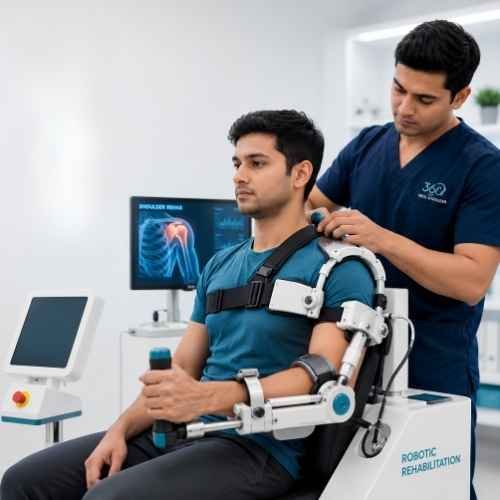
Robotic Scapular Motor Control Retraining — Precision Pattern Correction
Correcting scapular dyskinesia requires more than just strengthening the lower trapezius and serratus anterior — it requires rebuilding the precise timing, sequence, and coordination of scapular muscle activation throughout the full arc of arm elevation. Our robotic shoulder rehabilitation system delivers computer-guided resistance that can be precisely calibrated to load the scapular upward rotators at specific points in the elevation arc — training the correct neuromuscular pattern at the exact phase where dyskinesia is occurring, rather than generic strengthening that cannot target movement pattern correction with the same precision.
Precision Retraining
Our Mobilise–Activate–Integrate
Three-Stage Scapular Dyskinesia Physiotherapy Protocol
Scapular dyskinesia correction at 360 Neck Shoulder — serving patients from Noida and Greater Noida West at Sector 73 — addresses every contributing factor in the correct sequence: creating the thoracic and soft tissue mobility that allows correct scapular movement, activating the inhibited muscles that drive it, and integrating the corrected pattern into the full functional demands of daily, occupational, and athletic activity.
Stage 1 — Mobilise: Thoracic and Soft Tissue Preparation (Sessions 1–6)
No amount of scapular muscle training will produce correct scapular movement if the thoracic spine cannot extend to allow posterior scapular tipping and the pectoralis minor is too tight to allow scapular upward rotation. This stage focuses on restoring the structural prerequisites for correct scapular movement. Thoracic spine mobilization — extension over a foam roller, thoracic facet joint mobilization, and progressive thoracic extension exercises — restores the thoracic range that scapular posterior tipping requires. Pectoralis minor release — using TECAR Capacitive mode to reduce the tight, shortened pectoralis minor and manual stretching — frees the anterior scapular restriction that blocks upward rotation. Upper trapezius and levator scapulae release reduces the compensatory overactivity that was masking the lower trapezius and serratus weakness. Most patients notice immediate improvement in shoulder blade movement freedom after the first two to three sessions addressing these structural restrictions.
Stage 2 — Activate: Lower Trapezius and Serratus Anterior Retraining (Sessions 6–16)
With structural mobility restored, this stage rebuilds the neuromuscular activation of the specific muscles responsible for correct scapular upward rotation. Lower trapezius retraining begins in gravity-eliminated positions — prone Y and T exercises — where the inhibited muscle can be isolated and activated without compensation from the overactive upper trapezius. Serratus anterior retraining progresses from supine serratus punches through wall slides to the serratus push-up plus, ensuring the medial scapular border remains flat against the chest wall throughout the activation range. Our physiotherapists at 360 Neck Shoulder Noida monitor scapular movement quality during every exercise repetition — advancing only when the correct scapular pattern is reliably produced, rather than advancing based on a fixed session count regardless of movement quality.
Stage 3 — Integrate: Functional Scapular Control and Return to Activity (Sessions 16–24)
The isolated scapular control developed in Stage 2 must now be integrated into the full complexity of functional arm movements. Progressive overhead loading — from light resistance through the previously dyskinesic range, advancing to full overhead strength and endurance — trains the lower trapezius and serratus to maintain correct scapular rhythm under the loads and speeds of real daily function. Sport-specific overhead patterns — cricket bowling, badminton smashing, swimming strokes, gym pressing movements — are analysed for residual dyskinesia and corrected with specific technique feedback and loading progression. For desk workers from Greater Noida West, Gaur City, Noida Extension, and Crossings Republik, workstation ergonomics and a daily postural reset programme maintain the corrected scapular pattern through the working day. A structured home exercise programme ensures the rebuilt scapular motor control is maintained long after formal physiotherapy treatment in Noida concludes.
Patient Questions