Post Operative Shoulder
Rehabilitation in Noida
Surgery repairs the structure. Rehabilitation determines how much function you recover from it. Whether you have had a rotator cuff repair, Bankart repair, SLAP repair, or shoulder replacement — the quality of your post-operative physiotherapy in Noida is the single most important factor in translating a successful surgical outcome into lasting, full shoulder function. Get the most experienced post-shoulder surgery rehabilitation in Noida and Greater Noida West — surgeon-coordinated, protocol-driven, and built precisely around your specific procedure — from our clinic in Sector 73.


We Specialise in Rehabilitation After
After Shoulder Surgery:
Why What Happens Next Is as Important as the Operation Itself
Shoulder surgery — whether a rotator cuff repair, a Bankart stabilisation, or a shoulder replacement — achieves a structural goal: the torn tendon is reattached, the unstable labrum is secured, or the arthritic joint is replaced. What the surgery cannot do on its own is rebuild the muscle support system that was inhibited during months or years of pre-operative pain, retrain the neuromuscular coordination that chronic pain and injury disrupted, address the scar tissue that forms around the surgical site during healing, or progressively load the repaired or replaced structures back to the full demands of daily, occupational, and recreational life.
This is why patients who have technically successful shoulder surgery still frequently find themselves with persistent stiffness, insufficient strength, inability to lift overhead, or failure to return to sport — not because the surgery failed, but because the rehabilitation was incomplete, inadequately structured, or started too late. The surgical repair creates the structural foundation. The physiotherapy programme determines how much of that foundation is actually translated into real function.
The stakes are particularly high for rotator cuff repairs, where loading the healing tendon-to-bone junction too early — before adequate biological healing — is one of the most common causes of repair failure. And for Bankart repairs, where inadequate neuromuscular retraining leaves the patient with a structurally sound repair but a shoulder that still subluxes because the dynamic stabilization system was never rebuilt. And for shoulder replacements, where insufficient range of motion rehabilitation in the early weeks leads to permanent capsular scarring that limits function for years.
At 360 Neck Shoulder Advanced Rehabilitation Centre, Sector 73 Noida — the connecting corridor between Noida and Greater Noida West — our post-operative shoulder protocol is surgeon-coordinated at every stage, built around your specific procedure, and designed to take you progressively from protected early recovery to confident full function. We accept post-surgical patients from all hospitals across NCR.
Procedure-Specific Rehabilitation
Every Shoulder Surgery Needs
Its Own Specific Rehabilitation Protocol
Post-operative shoulder rehabilitation is not generic — each surgical procedure has a specific healing biology, a different timeline, and different rehabilitation priorities. Our protocols are procedure-specific from the first session.
- Rotator Cuff Repair Rehabilitation: The most critical shoulder post-operative protocol, because the tendon-to-bone healing biology strictly dictates the rehabilitation timeline. For the first four to six weeks (depending on repair size), the repaired tendon is protected with a sling and only passive motion is permitted — the patient's arm is moved gently through range without any active muscle contraction that would stress the healing repair. Active-assisted motion begins as the repair gains mechanical strength, and progressive strengthening is introduced only after the biological healing window has passed. Deviating from this timeline — allowing active use too early — is the primary cause of rotator cuff repair failure. Our physiotherapists at 360 Neck Shoulder Noida strictly adhere to the surgeon's protocol and never introduce loading before clearance is received.
- Bankart Repair and Labrum Repair Rehabilitation: Following arthroscopic Bankart repair, the repaired labral attachment requires protection from anterior translation forces in the early healing phase. Physiotherapy focuses on gentle passive motion within protected ranges, progressing to active motion and rotator cuff activation as the repair heals. The apprehension position — external rotation with abduction — is avoided until adequate tissue healing and neuromuscular control are established. Proprioceptive retraining and progressive sport-specific loading in the later phases restore the dynamic stability that complements the surgical structural repair.
- Shoulder Replacement (Arthroplasty) Rehabilitation: After total shoulder arthroplasty or reverse shoulder replacement, physiotherapy begins within days of surgery under the surgeon's protocol. Early passive and active-assisted range of motion prevents the capsular scarring that leads to permanent stiffness. Progressive strengthening of the rotator cuff and scapular stabilizers — particularly critical for reverse shoulder replacement where the deltoid becomes the primary elevator — rebuilds the muscular support for the prosthetic joint. Return to full daily function typically requires four to six months of structured physiotherapy in Noida.
- SLAP Repair and Capsular Release Rehabilitation: SLAP repair rehabilitation protects the repaired biceps anchor during early healing, with a graduated return to throwing and overhead activities over six to nine months. Capsular release rehabilitation after surgical frozen shoulder treatment focuses on aggressively maintaining the range of motion gained by the surgery — preventing re-scarring through consistent, progressive range of motion exercises from the first post-operative day.
TECAR Post-Surgical Tissue Therapy & Robotic Shoulder Rehabilitation
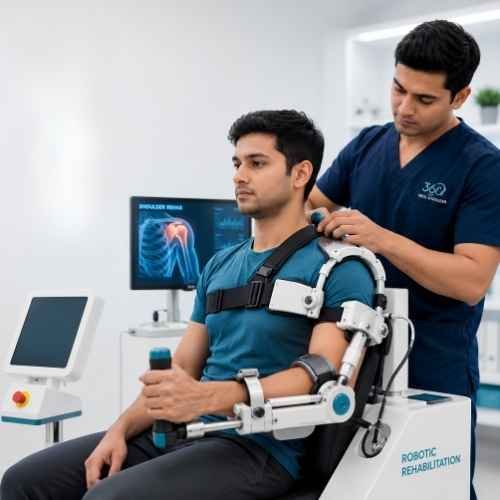
Our TECAR Capacitive mode reduces post-surgical soft tissue inflammation, accelerates scar tissue remodelling around the surgical site, and promotes the healthy collagen organisation of healing tissues — without the mechanical pressure of direct manual therapy on recently operated structures. As the surgeon's loading timeline progresses, our robotic shoulder rehabilitation system delivers precisely controlled, tension-monitored progressive strengthening — ensuring the healing tissues are loaded at exactly the right level at each stage of recovery.
Post-Op Protocol
Our Protect–Restore–Perform
Three-Stage Post-Operative Shoulder Protocol
Our post-operative shoulder protocol at 360 Neck Shoulder — serving patients from Noida and Greater Noida West at Sector 73 — follows a universal three-stage structure that is calibrated to the specific surgical procedure, healing biology, and surgeon's timeline at every step.
Stage 1 — Protect: Healing Phase Management and Early Function (Weeks 1–8)
The absolute priority is protecting the surgical repair during its biological healing window. Sling use, movement restrictions, and loading precautions are strictly followed as specified by the operating surgeon. TECAR Capacitive mode reduces post-surgical soft tissue inflammation and supports the healing environment without mechanical loading on the repair. Within the permitted range, gentle passive motion — provided by the physiotherapist, not by the patient's own muscles — maintains joint health, prevents adhesion formation, and keeps the surrounding tissues mobile without stressing the repair. Patient education covers expected recovery milestones, warning signs that warrant surgical follow-up, positioning and sleeping guidance, and the critical importance of not exceeding the surgeon's movement restrictions during this phase. Most patients from our physiotherapy clinic in Noida achieve meaningful early comfort and confidence within the first several sessions of this structured early phase.
Stage 2 — Restore: Mobility, Strength, and Neuromuscular Recovery (Weeks 8–20)
As the surgical clearance for progressive loading is received, this stage systematically rebuilds shoulder mobility and the muscular support system around the operated joint. Progressive range of motion exercises advance through the full elevation, rotation, and functional reach ranges. Rotator cuff and scapular strengthening — calibrated to the specific surgical procedure and healing stage — rebuilds the dynamic support that protects the repaired or replaced shoulder under daily loading. Neuromuscular retraining for Bankart and labrum repair patients restores the proprioceptive and rapid-response systems that were disrupted by the original injury and surgery. Scar management with TECAR releases any periarticular fascial restriction forming around the surgical site. Our physiotherapists at 360 Neck Shoulder Noida liaise with the surgeon throughout this phase and advance progression in line with surgical clearance and symptom response.
Stage 3 — Perform: Full Functional Return and Long-Term Shoulder Health (Weeks 20 Onward)
The final stage bridges clinical rehabilitation and the patient's actual daily, work, and recreational demands. Overhead endurance training builds the stamina for a full working day. Work-specific tasks — desk work, driving, manual handling, overhead occupational demands — are trained progressively. Sport-specific return programmes — for cricketers, gym athletes, badminton and tennis players from across Noida and Greater Noida West — are graduated through increasing load and speed toward full sport return, with criteria-based clearance at each step. A structured home maintenance programme ensures the strength, mobility, and shoulder health achieved through rehabilitation is maintained long after formal physiotherapy treatment in Noida is complete.
Patient Questions