
Shoulder Labrum Tear
Treatment in Noida
A deep catching pain in the shoulder during overhead movements or throwing, a feeling of the shoulder clicking or slipping, and the sense that your shoulder is not quite right even when the pain is manageable — these are the hallmark symptoms of a shoulder labrum tear. A diagnosis that often comes with an immediate recommendation for surgery — but for most labrum tears, structured physiotherapy is the appropriate first-line treatment and produces excellent outcomes. Get expert labrum tear rehabilitation in Noida and Greater Noida West at Sector 73 — dynamic stabilization, rotator cuff retraining, and a clear pathway to confident return to sport and daily life.




Recognize the Signs of a Shoulder Labrum Tear
Shoulder Labrum Tear:
Types, Diagnosis, and When Physiotherapy Works Better Than Surgery
A labrum tear diagnosis on MRI frequently triggers an immediate surgical referral — and yet research consistently shows that a significant proportion of labrum tears, including partial and some complete tears, achieve excellent functional outcomes with structured physiotherapy without surgical intervention. Understanding the different types of labrum tears, their specific symptom patterns, and the evidence for conservative versus surgical management is essential for every patient navigating this diagnosis.
The glenoid labrum is a ring of fibrocartilage attached to the rim of the glenoid socket. Its function is to deepen the relatively shallow socket — increasing the contact area between the humeral head and glenoid, improving joint stability, and providing the attachment point for the glenohumeral ligaments and the long head of biceps tendon. A labrum tear reduces socket depth and labral anchoring, compromising both passive stability and the biceps attachment — producing the characteristic instability, clicking, and catching symptoms.
Labrum tears are classified by their location on the labral ring. Bankart tears — at the anterior inferior labrum — are associated with anterior shoulder dislocation and produce instability symptoms, particularly in the externally rotated overhead position. SLAP tears (Superior Labrum Anterior to Posterior) — at the superior labrum and biceps anchor — are associated with overhead throwing sports and produce deep anterior shoulder pain, a catching sensation, and pain with biceps-loading activities. Posterior labrum tears produce posterior shoulder pain and instability in forward-flexed, internally rotated positions. Each type has a distinct clinical presentation and a distinct physiotherapy approach.
At 360 Neck Shoulder Advanced Rehabilitation Centre, Sector 73 Noida — serving patients from Noida and Greater Noida West on the main connecting corridor — our labrum tear physiotherapy protocol is tailored to the specific tear type and the patient's functional demands, with a clear, evidence-informed position on when surgery is and is not likely to produce better outcomes than conservative management.
Types of Labrum Tears
Bankart, SLAP, and Posterior:
Understanding Your Specific Labrum Tear
Each labrum tear type produces a distinct clinical pattern and requires a specific rehabilitation approach. Accurate diagnosis — combining clinical assessment and MRI arthrogram findings — determines the correct physiotherapy programme.
- Bankart Tear (Anterior Inferior Labrum): The most common labrum tear, typically following anterior shoulder dislocation. The labrum is detached from the anterior glenoid rim, reducing passive resistance to anterior humeral displacement and producing shoulder apprehension and instability in overhead externally rotated positions. Young cricket players, footballers, and kabaddi athletes from across Noida and Greater Noida West are the highest-risk group. Conservative management with dynamic stabilization physiotherapy is appropriate for first-time presentations without significant bony involvement. Surgical arthroscopic Bankart repair is recommended for high-demand young athletes with recurrent instability or significant glenoid bone loss.
- SLAP Tear (Superior Labrum Anterior to Posterior): A tear of the superior labrum at the biceps anchor point, most common in overhead throwing athletes — cricket bowlers, swimmers, and badminton players from the sports communities of Noida and Greater Noida West. Produces deep anterior shoulder pain, a catching sensation during the cocking phase of throwing, pain with resisted biceps activities, and sometimes a clunking during shoulder rotation. The O'Brien test and Biceps Load test are specific clinical assessments that identify SLAP tears. Conservative physiotherapy — biceps tendon deloading, rotator cuff strengthening, and throwing mechanics correction — is effective for many SLAP tears, particularly in patients over 40 where the tear is degenerative.
- Posterior Labrum Tear: Less common, associated with posterior shoulder instability from heavy bench pressing, blocking, or posterior-loading sports mechanisms. Produces posterior shoulder pain and instability in forward flexion and internal rotation — the position of heavy pressing or pushing. Physiotherapy targeting posterior rotator cuff strength and posterior capsule integrity is the primary management approach.
- Complex and Multi-directional Tears: Some labrum tears involve multiple quadrants of the labral ring, often in the context of generalized joint hypermobility or after significant trauma. These require comprehensive assessment to determine the most appropriate management pathway and whether surgical stabilization is needed alongside physiotherapy.
TECAR Periarticular Therapy & Robotic Neuromuscular Stabilization
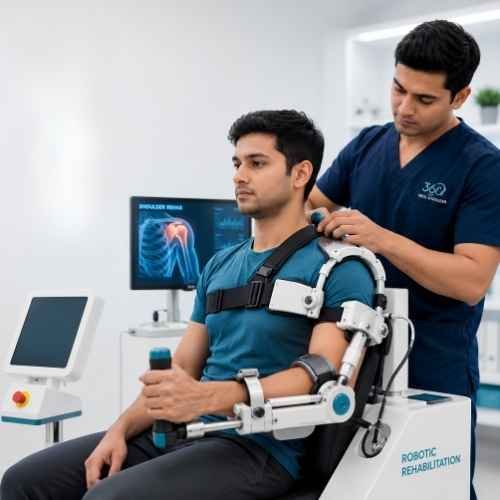
Our TECAR Capacitive mode reduces periarticular inflammation surrounding the torn labrum and joint capsule — creating the low-inflammation environment that optimises both natural labral healing and the connective tissue response around the tear. Our robotic shoulder system delivers precision neuromuscular stabilization training — building the rotator cuff dynamic stability that compensates for the reduced passive stability from the torn labrum — in the exact movement planes that correspond to each patient's specific tear type and instability direction.
Precision Protocol
Our Settle–Stabilise–Perform
Three-Stage Labrum Tear Physiotherapy Protocol
Our labrum tear physiotherapy protocol at 360 Neck Shoulder — serving patients from Noida and Greater Noida West at Sector 73 — is tailored to the specific tear type, surgical or conservative pathway, and the patient's sport or occupational demands.
Stage 1 — Settle: Acute Phase Management and Activity Modification (Weeks 1–6)
The first priority is reducing the periarticular inflammation that accompanies the acute labrum injury, implementing precise activity modification that avoids the specific movements provocative for the patient's tear type, and beginning the earliest safe rotator cuff activation. TECAR Capacitive mode reduces joint inflammation and supports the healing environment. For SLAP tears, biceps-loading activities are avoided. For Bankart tears, externally rotated overhead positions are restricted. Pendulum exercises and gentle pain-free range of motion maintain joint health without stressing the healing or torn labral tissue. Most patients at our physiotherapy clinic in Noida establish meaningful early symptom control within the first four to six sessions.
Stage 2 — Stabilise: Dynamic Stabilization and Neuromuscular Retraining (Weeks 6–18)
Progressive rotator cuff strengthening — targeted to the specific instability direction of the patient's tear type — rebuilds the dynamic stabilization that compensates for the torn labrum's reduced passive contribution. For Bankart tears, subscapularis activation is the primary target. For SLAP tears, biceps tendon deloading exercises and posterior rotator cuff strengthening redistribute force away from the compromised anchor. Proprioceptive retraining restores the joint position sense and rapid protective responses disrupted by the labral injury. Scapular stabilization training provides the stable base from which rotator cuff dynamic protection operates. Our physiotherapists at 360 Neck Shoulder Noida advance these exercises through the progressively provocative ranges as strength and neuromuscular control improve.
Stage 3 — Perform: Sport-Specific Loading and Return to Full Activity (Weeks 18–28)
Return to throwing, overhead sport, contact sport, or heavy occupational demands is criteria-based — strength symmetry, clinical instability test clearance, and pain-free sport-specific movement. Cricket bowling reintegration for overhead athletes from Noida and Greater Noida West uses a graduated ball-throwing programme with biomechanics monitoring. Gym training is returned progressively with technique corrections that eliminate the loading patterns that provoked the original labrum injury. For patients who proceed to surgical labrum repair, our post-operative rehabilitation follows the specific surgical repair protocol in coordination with the operating surgeon, ensuring the repaired labrum is protected during early healing and progressively loaded through to full sport return.
Patient Questions