Anterior Shoulder Dislocation
Rehabilitation in Noida
A shoulder dislocation is one of the most painful and alarming acute injuries — but what happens after reduction determines everything. Without structured rehabilitation, the recurrence rate in young active patients exceeds 70–80%. The torn anterior capsule, stretched rotator cuff, and disrupted proprioception that remain after reduction will not heal adequately with rest alone. Get the most structured post-dislocation shoulder rehabilitation in Noida and Greater Noida West — rebuilding dynamic stability, preventing recurrence, and returning you safely to sport and full activity.




After Dislocation — What Needs to Be Rehabilitated
Anterior Shoulder Dislocation:
Why Rehabilitation After Reduction Decides Everything
Anterior shoulder dislocation is the most common major joint dislocation seen in emergency departments — and one of the most under-rehabilitated injuries thereafter. Once the shoulder has been reduced (put back into place), patients are frequently discharged with a sling, a prescription for painkillers, and instructions to "rest and follow up in a few weeks." What is not routinely provided is the structured physiotherapy that addresses the specific structural damage the dislocation caused — and without which, particularly in young active patients, the probability of recurrent dislocation is alarmingly high.
When the humeral head is forced anteriorly out of the glenoid during a dislocation, it causes a predictable pattern of injury. The anterior capsule and labrum are torn from the glenoid rim — the Bankart lesion — reducing the passive barrier to re-dislocation. The back of the humeral head impacts the glenoid rim, creating a Hill-Sachs compression fracture. The rotator cuff is stretched and its neuromuscular activation disrupted. The axillary nerve, running directly beneath the glenohumeral joint, is frequently stretched — producing temporary numbness and weakness over the outer shoulder. Together, these injuries significantly compromise the shoulder's stability and leave it highly vulnerable to recurrence during any activity that places the arm in the externally rotated, abducted position that produced the original dislocation.
The recurrence rate after first-time anterior dislocation is strongly age-dependent. In patients under 25 — young cricketers, gym athletes, kabaddi and football players from across Noida and Greater Noida West — recurrence rates without structured rehabilitation exceed 70 to 80 percent. This is not because re-dislocation is inevitable, but because the structural damage from the first event is not adequately addressed. The torn labrum does not heal robustly with rest alone. The rotator cuff neuromuscular response that would protect the shoulder from re-displacement is not rebuilt with a sling.
At 360 Neck Shoulder Advanced Rehabilitation Centre, Sector 73 Noida — the connecting corridor between Noida and Greater Noida West — our post-dislocation rehabilitation protocol systematically rebuilds every compromised structure: rotator cuff strength, dynamic joint centration, shoulder proprioception, and sport-specific stability under the exact loading demands the patient will return to.
Structural Damage & Rehabilitation Targets
What Gets Damaged in Anterior Dislocation:
And What Physiotherapy Must Rebuild
Effective post-dislocation physiotherapy requires understanding which structures were damaged and what each requires from rehabilitation to restore adequate stability.
- Bankart Labral Tear — Passive Stabilizer Loss: The anterior inferior labrum is torn in the majority of first-time anterior dislocations, particularly in younger patients. This reduces the depth of the glenoid socket and removes the primary passive barrier to anterior humeral head displacement. Physiotherapy cannot repair a torn labrum, but targeted rotator cuff dynamic stabilization can compensate for the loss of passive restraint in most patients with partial or moderate labral tears — which is the evidence base for conservative management as first-line treatment in selected patients.
- Anterior Capsule Stretch and Laxity: The anterior glenohumeral ligaments are stretched or partially torn during dislocation, contributing to increased passive laxity of the joint. Progressive subscapularis and rotator cuff strengthening directly compensates for this laxity by providing active resistance to anterior humeral translation during provocative arm positions.
- Rotator Cuff Inhibition and Neuromuscular Disruption: Pain, swelling, and neural injury following dislocation significantly inhibit the rotator cuff's normal protective neuromuscular response. This inhibition — the inability to rapidly contract the rotator cuff to protect the joint when it approaches instability — is a primary driver of recurrent dislocation. Proprioceptive retraining and neuromuscular re-education exercises specifically restore this protective reflex arc.
- Axillary Nerve Injury: The axillary nerve provides sensation to the outer shoulder and motor supply to the deltoid. Stretch injury during dislocation produces temporary numbness over the lateral deltoid, which typically resolves within six to twelve weeks. Significant axillary nerve injury with persistent deltoid weakness requires specific nerve recovery monitoring and targeted deltoid retraining as the nerve heals.
Robotic Shoulder Stabilization & TECAR Post-Dislocation Recovery
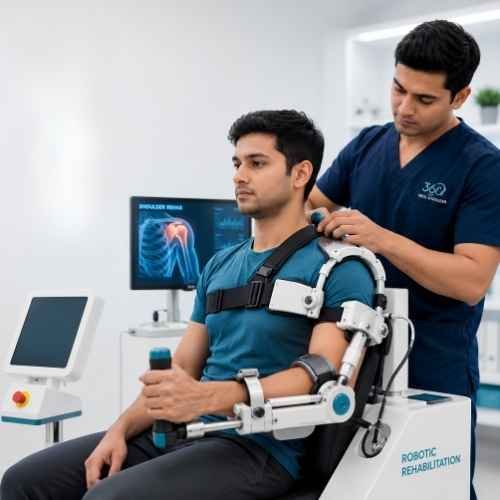
Our TECAR Capacitive mode reduces post-dislocation soft tissue inflammation in the anterior capsule, labrum, and rotator cuff — accelerating early tissue healing and reducing protective guarding that delays rehabilitation progress. Our robotic shoulder retraining system then delivers computer-guided, tension-monitored neuromuscular activation exercises at precisely controlled resistance and movement parameters — building the rotator cuff's dynamic stabilization capacity in the exact directions needed to prevent re-dislocation, without exposing the healing structures to provocative loading.
Stability Protocol
Our Heal–Stabilise–Return
Three-Stage Post-Dislocation Rehabilitation Protocol
Our anterior dislocation rehabilitation protocol at 360 Neck Shoulder — serving patients from Noida and Greater Noida West at Sector 73 — progresses systematically from protecting healing structures, through building dynamic stability, to confident return to full sport and daily demands.
Stage 1 — Heal: Post-Reduction Management and Early Activation (Weeks 1–6)
Sling use is guided by symptom severity and imaging findings — typically two to three weeks for comfort, not prolonged immobilisation. TECAR Capacitive mode reduces acute post-dislocation inflammation in the anterior capsule and surrounding soft tissues. Isometric rotator cuff activation begins within the first week — maintaining muscle tone and initiating the neuromuscular retraining pathway without stressing the healing Bankart and capsular structures. Range of motion is progressively restored within pain tolerance, avoiding the externally rotated overhead position that is provocative for anterior instability until adequate rotator cuff protection is established. Axillary nerve recovery is monitored with serial sensation and deltoid strength testing.
Stage 2 — Stabilise: Dynamic Stability Rebuilding and Proprioceptive Retraining (Weeks 6–18)
The critical phase that determines recurrence risk. Progressive subscapularis strengthening — in isolation and in functional patterns — rebuilds the primary dynamic restraint to anterior humeral displacement. Infraspinatus and teres minor strengthening restores the posterior rotator cuff force couple that keeps the humeral head centred during apprehension-provoking positions. Proprioceptive retraining — through perturbation training, closed-chain stability exercises, and progressive apprehension position exposure — restores the rapid protective neuromuscular response that prevents re-dislocation when the shoulder approaches its instability threshold. Our physiotherapists at 360 Neck Shoulder Noida advance this programme in a structured progression that systematically builds confidence and neuromuscular protection through the previously provocative range.
Stage 3 — Return: Sport-Specific Loading and Return-to-Activity Clearance (Weeks 18–28)
Return to sport is never time-based — it is criteria-based. Strength symmetry between shoulders must reach at least 90 percent. Apprehension test must be negative under provocation. Sport-specific loading — throwing mechanics for cricketers, tackling positions for contact athletes, overhead stroke patterns for badminton players, gym press and pull patterns — must be well tolerated before clearance. Young athletes from sports communities across Noida, Greater Noida West, Gaur City, Noida Extension, and Crossings Republik receive sport-specific movement analysis and gradual return-to-training progression to minimise re-injury risk at the most critical moment.
Patient Questions