
Dowager's Hump
Treatment in Noida
That visible rounding at the base of the neck — the hump that has been quietly growing over months or years — is not just a posture problem. It is a structural change driven by a forward-flexing thoracic spine, weakened postural muscles, and years of forward head loading. The good news: a postural Dowager's Hump is correctable — with the right combination of thoracic mobilization, targeted strengthening, and postural re-education. Get Noida's most advanced, evidence-based hump correction protocol — without surgery.




Recognize the Signs of Dowager's Hump
Dowager's Hump:
Not Just Bad Posture — a Structural Change That Grows Over Time
Almost every patient who comes to us with this condition says the same thing: they noticed the hump in a photo, or someone pointed it out, or they caught their reflection and did not recognize their own profile. What they are seeing is not simply poor posture that will correct itself if they just "sit up straight." By the time a Dowager's Hump is visibly prominent, a series of structural adaptations have already taken place in the cervicothoracic junction — and these need to be specifically addressed, not just reminded of.
The clinical name for the underlying problem is cervicothoracic hyperkyphosis — an excessive forward curve at the junction where the neck meets the upper back, centred around the C7–T1 vertebral levels. As the thoracic spine curves forward beyond its normal range, the body compensates by extending the upper cervical spine backward so the eyes remain level with the horizon. This creates the characteristic visual pattern: rounded upper back, forward head, and a prominent bony ridge at the base of the neck where C7 and T1 vertebrae push posteriorly as the surrounding thoracic spine curves forward.
In purely postural cases — by far the most common presentation, especially in desk-based and screen-dependent patients — the hump consists of stiff, compressed thoracic spinal joints, shortened and overactive anterior chest muscles and cervical flexors, severely weakened thoracic extensor muscles and deep cervical flexors, and in long-standing cases, a pad of fibrous and adipose (fatty) tissue that accumulates over the bony prominence. This soft tissue component is what gives the hump its rounded, padded appearance beyond the bony ridge itself.
In older patients, particularly postmenopausal women, osteoporosis-related vertebral compression fractures at the thoracic level can accelerate the curvature, adding a structural bony component that cannot be fully reversed with physiotherapy alone — though physiotherapy remains essential for managing pain and preventing further progression. Identifying which category a patient falls into is the first step in any effective treatment plan.
At 360 Neck Shoulder Advanced Rehabilitation Centre, our approach to Dowager's Hump is built on a clear clinical sequence: mobilize the stiff thoracic joints first to create the movement capacity for posture to change, then systematically rebuild the weakened muscles that must sustain the corrected position, and finally re-educate the habitual postural patterns that caused the hyperkyphosis in the first place. Without all three stages, improvements in one area are rapidly lost.
Root Causes & Risk Factors
What Drives Dowager's Hump:
From Screen Posture to Bone Density Changes
Dowager's Hump develops from a convergence of mechanical, muscular, and in some cases metabolic factors — all of which are now increasingly relevant across younger age groups in Noida's desk-based workforce.
- Sustained Forward Head and Thoracic Flexion Posture ('Tech Neck'): Hours of daily screen use — laptop, desktop monitor, and smartphone — keep the thoracic spine in sustained forward flexion and the head well forward of the shoulders. Over months and years, this position becomes the spine's default resting posture: the thoracic joints adapt to the flexed position, the anterior muscles shorten, and the posterior extensors lengthen and weaken. The cervicothoracic junction progressively rounds forward, and the hump emerges. This is now the most common driver of Dowager's Hump in patients under 50 presenting at our clinic.
- Thoracic Extensor and Deep Cervical Flexor Weakness: The muscles responsible for holding the thoracic spine upright — the thoracic erector spinae, rhomboids, middle and lower trapezius — become progressively weaker when the thoracic spine spends most of its time in flexion. Simultaneously, the deep cervical flexors that support proper head alignment are inhibited. This muscular imbalance means that even when patients consciously try to sit up straight, the muscles cannot sustain the corrected position for more than a few minutes — allowing the thoracic spine to fall back into flexion repeatedly.
- Osteoporosis and Vertebral Compression Fractures: In older adults, reduced bone density causes the anterior portion of thoracic vertebral bodies to gradually compress under normal spinal loading — producing a wedge-shaped deformity that permanently increases thoracic kyphosis. This is the traditional, osteoporosis-driven Dowager's Hump. While the bony deformity itself cannot be fully corrected, physiotherapy substantially reduces pain, improves the surrounding muscle support, and slows further progression, making it a cornerstone of management even in this group.
- Prolonged Gravity Load Without Recovery: The human spine accumulates gravitational load throughout the day — discs compress, soft tissues tighten, and the thoracic curve gradually increases under body weight. Without adequate movement breaks, thoracic extension exercise, and appropriate sleep posture to allow overnight recovery, this daily accumulation gradually sets the thoracic kyphosis further forward over time.
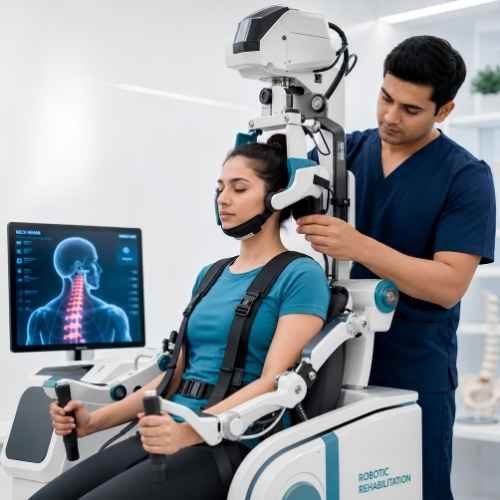
TECAR Thoracic Mobilization & Postural Muscle Re-Activation
Our TECAR system applies targeted radiofrequency energy to the chronically stiff thoracic paraspinal muscles and facet joints at the cervicothoracic junction — generating deep endogenous heat that reduces joint stiffness and soft tissue restriction, creating the movement capacity the thoracic spine needs to extend. This is combined with progressive thoracic extensor activation and deep cervical flexor retraining, building the muscular endurance to hold the corrected posture throughout the working day.
Posture Correction
Our Mobilise–Strengthen–Sustain
Three-Stage Correction Protocol
Effective Dowager's Hump treatment requires all three stages in sequence. Strengthening a stiff spine produces minimal postural change. Mobilizing without rebuilding the muscles means the improved range is immediately lost. And neither works if the daily postural habits that drive the condition forward are not permanently corrected.
Stage 1 — Thoracic Joint Mobilization & Soft Tissue Release (Sessions 1–8)
A stiff, hyperkyphotic thoracic spine cannot be straightened until the joints and surrounding tissues have regained their capacity to extend. TECAR therapy targets the thoracic paraspinal muscles and the compressed facet joints at the cervicothoracic junction, reducing the chronic stiffness that has accumulated over months or years of sustained flexion loading. Manual thoracic mobilization and extension techniques restore segmental movement at the key restricted levels. Targeted chest and anterior shoulder stretching lengthens the chronically shortened pectoral and anterior cervical tissues that pull the thorax forward. Patients typically begin to feel meaningful improvement in upper back mobility and a reduction in the chronic aching by sessions four to six.
Stage 2 — Postural Muscle Restrengthening & Endurance Building (Sessions 8–18)
Once the thoracic spine has regained sufficient mobility to move into a more upright position, this stage systematically rebuilds the muscles that must sustain it there. Thoracic extensor strengthening — targeting the erector spinae, rhomboids, and middle and lower trapezius — progressively increases the endurance of the muscles responsible for holding the thoracic spine upright against gravity. Deep cervical flexor retraining corrects the habitual hyperextension of the upper neck that compensates for thoracic kyphosis. Scapular retraction strengthening pulls the shoulder blades back into their correct position, removing the forward shoulder posture that contributes to the rounded appearance. Importantly, this stage focuses on endurance as much as strength — because postural muscles must work continuously throughout the day, not just during a two-minute exercise set.
Stage 3 — Postural Habit Re-Education & Long-Term Prevention (Sessions 18–24)
The stage that determines whether results are permanent or temporary. We work with each patient to analyse and specifically correct their actual daily postural exposures: monitor height and distance at their desk, armrest and chair configuration, smartphone and reading positions, sleeping posture, and habitual standing position. A structured daily home programme — specifically designed to counteract the exact postural loading pattern each patient's work and lifestyle creates — is established and progressively advanced. Patients with osteoporosis are screened and referred appropriately for bone density management alongside physiotherapy. Without this stage, the daily postural forces that built the hump will steadily rebuild it.
Patient Questions