
Brachial Plexus Injury
Treatment in Noida
An arm that feels weak, numb, or unresponsive after an accident, fall, or shoulder injury needs urgent, accurate evaluation — every week of delay can affect your recovery window. Brachial Plexus Injury affects the nerve network controlling your entire arm and hand. Get Noida's most experienced nerve injury assessment, structured neuromuscular rehabilitation, and fast-tracked specialist referral when surgery is needed.



Recognize the Warning Signs of Brachial Plexus Injury
Brachial Plexus Injury:
When the Nerve Network Powering Your Arm Is Damaged
Most patients who come to us with this condition have just been through a frightening event — a motorcycle accident, a fall from height, a sports collision — and now find an arm that will not respond the way it used to. Weak, numb, hanging limp, or burning with pain that travels from the shoulder down to the fingers. This is not a simple sprain or muscle strain. This points to damage in the brachial plexus — the network of nerves that carries every movement and sensation signal between your spinal cord and your arm.
The brachial plexus originates from five nerve roots in the lower neck (C5 to T1) and branches out through the shoulder to supply the entire arm, forearm, and hand. Because it is essentially the "wiring" for your whole upper limb, an injury anywhere along this network can disrupt strength, sensation, and coordination far from the original injury site. Severity exists on a spectrum: a neuropraxia is a stretch injury to the nerve that often recovers on its own; an axonotmesis involves damage to the nerve fibers within an intact outer sheath; and an avulsion is a complete tear of the nerve root from the spinal cord — the most severe form, which does not heal without surgery.
This is why accurate, early classification matters more in brachial plexus injury than in almost any other neck or shoulder condition. A mild stretch injury managed correctly can recover with structured physiotherapy alone. A severe avulsion misdiagnosed as "just a strain" and left untreated for months can mean a permanently non-functional arm, because the window for the best surgical outcomes — nerve grafting or nerve transfer — narrows significantly after the first three to six months.
At 360 Neck Shoulder Advanced Rehabilitation Centre, our approach is built on this exact principle: every brachial plexus injury gets a precise neurological work-up first, so the right treatment path — conservative rehabilitation or urgent surgical referral — is identified without delay. Alongside this, we begin protective rehabilitation immediately to preserve joint mobility and muscle health while the nerve recovers or while a surgical decision is made.
Root Causes & Risk Factors
What Causes Brachial Plexus Injury:
From Road Trauma to Birth Injury
Brachial plexus injuries arise from forceful stretching, compression, or tearing of the nerve network, with the mechanism of injury directly influencing severity and the most appropriate treatment pathway.
- Road Traffic Accidents (Most Common Cause in Adults): High-speed motorcycle and car accidents are the leading cause of severe brachial plexus injury, particularly when the head and shoulder are forcefully driven apart during impact. This mechanism — common on Noida-Greater Noida Expressway and NH-24 traffic corridors — frequently produces the most severe injury patterns, including nerve root avulsion.
- Falls and Sports Collisions: A fall onto an outstretched arm, a hard tackle in contact sports, or a direct blow to the shoulder can stretch or compress the brachial plexus. These injuries range from mild "stinger" or "burner" sensations that resolve within minutes to more significant stretch injuries requiring full clinical evaluation.
- Shoulder Dislocation: A dislocated shoulder can stretch the brachial plexus as the joint moves out of position, and the nerve injury may not become apparent until after the dislocation itself is treated, which is why post-dislocation neurological screening is an essential and sometimes overlooked step.
- Birth-Related Brachial Plexus Injury (Erb's Palsy): During a difficult delivery, particularly with shoulder dystocia, excessive traction on a newborn's neck and shoulder can injure the brachial plexus, most commonly affecting the upper nerve roots (C5-C6) and producing the classic "waiter's tip" arm posture. Early identification and structured infant physiotherapy significantly influence long-term outcomes.
TECAR Nerve-Healing Therapy & Robotic Neuromuscular Re-Education
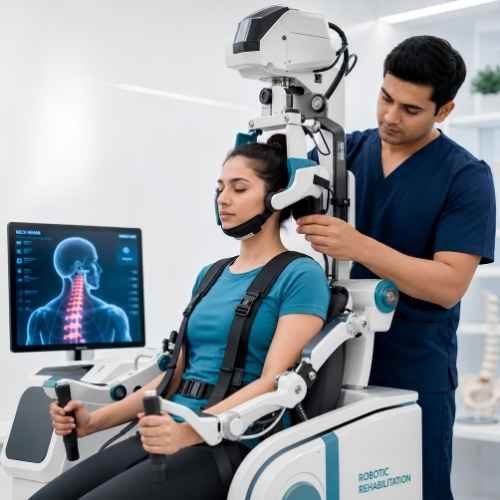
Our specialized TECAR system improves local circulation around the injured nerve pathway to support the biological nerve-healing environment, while our robotic-assisted re-education system provides precise, repeatable movement patterns that help retrain weakened muscles as nerve signals gradually return. Combined with functional electrical stimulation, this approach keeps muscle tissue responsive during the nerve regeneration period, when disuse atrophy is the biggest threat to eventual functional recovery.
Support Tech
Our Screening-First,
Three-Stage Clinical Pathway
Because brachial plexus injury severity ranges from a recoverable stretch to a surgical emergency, our pathway is built around accurate early classification first — ensuring every patient reaches the right level of care within the critical early treatment window.
Stage 1 — Neurological Mapping & Injury Severity Classification (Visit 1)
Every suspected brachial plexus injury begins with detailed manual muscle testing across all major shoulder, elbow, wrist, and hand movements, combined with sensory mapping to identify exactly which nerve roots or trunks are affected. We take a thorough history of the injury mechanism, prior imaging, and any nerve conduction study results if already performed. Where features suggest a severe injury — complete paralysis, absent sensation, or a high-velocity injury mechanism — we coordinate immediate referral to a brachial plexus surgery specialist, since surgical timing is one of the strongest predictors of functional recovery in severe cases.
Stage 2 — Protective Rehabilitation During Nerve Recovery or Pre-Surgical Period
While nerves heal naturally or while a surgical decision is being finalized, we focus on protecting the arm from the secondary damage that disuse causes — passive range of motion to prevent joint stiffness, particularly frozen shoulder, gentle nerve gliding exercises to maintain nerve mobility through surrounding tissue, and positioning education to prevent contractures. This stage is frequently skipped in conventional care, yet it directly determines how much function the arm will be able to use once nerve signals return.
Stage 3 — Neuromuscular Re-Education & Functional Strength Rebuilding
As nerve signals progressively return — whether through natural regeneration or following surgical repair — this stage uses robotic-assisted re-education, functional electrical stimulation, and graded strengthening to help the brain and muscles relearn coordinated movement patterns. Because nerves regenerate slowly, this stage often continues over many months, with therapy progressively advancing from proximal shoulder control through to fine hand and finger function as the nerve signal reaches each muscle group in turn.
Patient Questions