Cervical Myelopathy
Treatment in Noida
Dropping things more often, hands feeling clumsy with buttons or handwriting, or a subtle change in how steady you feel on your feet — even without significant neck pain — can be early signs of spinal cord compression in the neck. Cervical Myelopathy is a progressive condition that needs accurate screening and timely action. Get Noida's most experienced clinical evaluation, structured rehabilitation, and coordinated specialist referral when it matters most.




Recognize the Warning Signs of Cervical Myelopathy
Cervical Myelopathy:
When the Spinal Cord Itself Is Under Pressure
Most patients who come to us for this condition do not arrive complaining of severe neck pain. They arrive saying their handwriting has gotten worse, they keep dropping their phone, or their spouse has noticed they seem less steady walking down stairs. These are not signs of "getting older" to be dismissed. When they appear together — clumsy hands, an unsteady gait, and subtle loss of fine motor control — they point toward something far more specific: compression of the spinal cord within the neck. This is Cervical Myelopathy.
Unlike conditions that irritate a single nerve root, myelopathy involves the spinal cord itself — the central trunk line carrying every motor and sensory signal between the brain and the rest of the body below the neck. When the cervical spinal canal narrows, most commonly due to age-related disc degeneration, bone spur (osteophyte) formation, or thickening of the ligamentum flavum, the cord is gradually compressed. Because the cord governs coordinated movement throughout the body, the resulting symptoms are often diffuse: fine motor difficulty in the hands, gait imbalance, and in advanced cases, changes in bowel or bladder function — frequently with little or no neck pain to signal that anything is wrong in the spine.
This is what makes cervical myelopathy clinically important to identify early. It typically follows a progressive course, meaning that without appropriate evaluation, function tends to decline gradually — and unlike many neck conditions, the spinal cord has a limited capacity to recover once significantly compressed or injured. The therapeutic priority is therefore not simply symptom relief, but accurate early screening, monitoring, and timely escalation to the right level of care.
At 360 Neck Shoulder Advanced Rehabilitation Centre, our approach to myelopathy is built on this principle: our role is to recognize the condition accurately, support function through structured rehabilitation, and ensure you reach a spine surgeon or neurosurgeon without delay whenever red-flag features are present. For confirmed mild, stable cases under specialist supervision, we also provide structured conservative care and pre- and post-operative rehabilitation support.
Root Causes & Risk Factors
What Causes Cervical Myelopathy:
From Degenerative Narrowing to Chronic Loading
Cervical myelopathy results from structural narrowing of the spinal canal, with several contributing degenerative and mechanical factors — some of which are increasingly observed earlier in Noida's desk-based working population.
- Cervical Spondylotic Changes (Most Common Cause): Age-related disc degeneration leads to disc height loss and bulging, while the body responds by forming bone spurs (osteophytes) at the disc margins and facet joints. Over years, this combination progressively narrows the spinal canal — a process called cervical spondylotic myelopathy, the leading cause of spinal cord dysfunction in adults over 50.
- Ligamentum Flavum Thickening (Hypertrophy): The ligamentum flavum, a band of tissue running along the back of the spinal canal, can thicken and buckle inward with age and chronic mechanical stress, further reducing the available space for the spinal cord — frequently acting alongside disc and bone changes to compound compression.
- Congenital Spinal Canal Narrowing: Some individuals are born with a naturally narrower cervical spinal canal. While this alone may not cause symptoms, it significantly reduces the safety margin available, meaning even modest degenerative changes or a minor neck injury can trigger the onset of myelopathic symptoms earlier than in someone with a normal canal diameter.
- Cumulative Mechanical Loading from Chronic Forward Head Posture: While posture alone does not cause myelopathy, sustained forward head posture from prolonged desk and screen work accelerates disc degeneration and facet joint wear over time. Across Noida's IT and corporate sectors, this chronic loading pattern is increasingly implicated in degenerative cervical spine changes presenting at a younger age than traditionally expected.
Clinical Myelopathy Screening & Robotic-Assisted Functional Rehabilitation
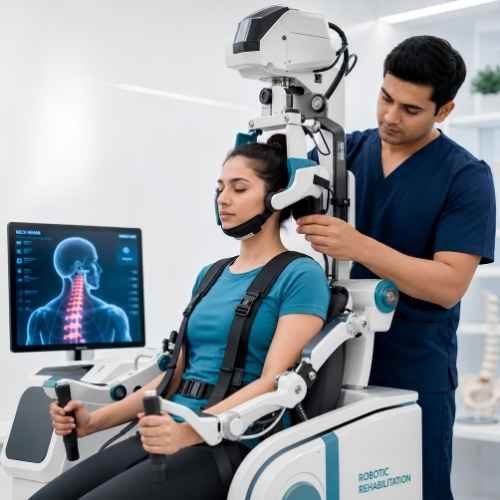
Our assessment combines structured neurological screening — fine motor testing, gait analysis, and reflex evaluation — with robotic-assisted rehabilitation for confirmed stable cases and for patients before and after spinal surgery. This allows us to track functional change objectively over time and ensure any deterioration is identified and escalated promptly, rather than being masked by generic exercise alone.
& Safe Rehab
Our Screening-First,
Three-Stage Clinical Pathway
Because cervical myelopathy can be a serious, progressive condition, our pathway is built around accurate triage first — ensuring every patient reaches the right level of care at the right time, rather than receiving generic physiotherapy for a condition that may require surgical attention.
Stage 1 — Comprehensive Neurological Screening & Red-Flag Assessment (Visit 1)
Every suspected myelopathy case begins with a detailed clinical screening: fine motor testing of the hands, gait and balance assessment, deep tendon reflex testing, and specific provocative tests including Hoffmann's sign and Lhermitte's sign. We take a thorough history of symptom progression, prior imaging if available, and any bowel or bladder changes. Where red-flag features or significant functional decline are present, we coordinate immediate referral to a spine surgeon or neurosurgeon for MRI confirmation and surgical opinion — myelopathy is not a condition where "wait and watch" is appropriate once cord compression is suspected.
Stage 2 — Coordinated Specialist Pathway or Structured Conservative Care
For patients confirmed to have significant cord compression or progressive symptoms, we actively coordinate with our network of spine surgeons and neurosurgeons to ensure timely surgical decompression, since outcomes are consistently better when surgery is performed before significant or prolonged cord damage occurs. For patients with mild, stable myelopathy under specialist supervision and confirmed unsuitable or not yet indicated for surgery, we provide structured, closely monitored conservative care, including activity modification, cervical stabilization exercises within safe limits, and regular reassessment to catch any progression early.
Stage 3 — Pre-Operative Conditioning & Post-Operative Functional Rehabilitation
For patients proceeding to surgery, we provide pre-operative conditioning to optimize strength and function ahead of the procedure, and structured post-operative rehabilitation afterward — including robotic-assisted mobility training, gait re-education, and fine motor retraining for the hands. This staged functional recovery is essential to help patients regain as much coordination and independence as possible following decompression, working in coordination with the operating surgeon's protocol throughout.
Patient Questions