
Cervicogenic Vertigo
Treatment in Noida
Dizziness or a spinning, unsteady sensation that gets worse when you turn your head, look up, or sit at a desk for hours is often not an inner ear problem at all. It is Cervicogenic Vertigo — dizziness caused by faulty positional signals from your neck. Get Noida's most advanced, clinically proven upper-cervical rehabilitation protocol — without long-term anti-vertigo medication.




Recognize the Warning Signs of Cervicogenic Vertigo
Cervicogenic Vertigo:
When Your Neck Is Confusing Your Sense of Balance
Most patients who come to us have already seen an ENT specialist, had inner ear tests come back normal, and still walk away with unexplained dizziness. But when your dizziness is triggered or worsened by turning your head, feels more like swaying or unsteadiness than true spinning, and consistently appears alongside neck stiffness or a dull headache at the base of the skull — that dizziness may not be coming from your inner ear at all. It may be coming from your neck. This is Cervicogenic Vertigo.
The mechanism is well documented in clinical literature: the upper cervical spine contains a dense network of proprioceptors — specialized sensors that continuously report the exact position of your head to your brain. This cervical positional information is integrated with signals from your inner ear (vestibular system) and your eyes to maintain a stable sense of balance. When the upper cervical facet joints become dysfunctional, or the suboccipital muscles surrounding them grow chronically tight, they send distorted positional signals into this system — and the conflict between what your neck reports and what your eyes and ears report is what your brain registers as dizziness.
This is fundamentally different from BPPV (inner ear crystal displacement, producing brief intense spinning with specific head positions) and vestibular neuritis (constant, severe vertigo often with hearing changes). Cervicogenic vertigo is mechanically reproducible — it tracks closely with neck position and neck symptoms, and tends to ease once the neck is at rest, rather than appearing as sudden, unprovoked spinning episodes.
At 360 Neck Shoulder Advanced Rehabilitation Centre, our clinical approach is built on this exact mechanism: dizziness caused by the neck cannot be permanently resolved by medication that targets only the inner ear. Our staged protocol directly addresses the upper cervical joints, suboccipital muscles, and proprioceptive signaling responsible for triggering your dizziness — for lasting, mechanism-based relief.
Root Causes & Risk Factors
What Triggers Cervicogenic Vertigo:
From Proprioceptive Confusion to Desk Posture
Cervicogenic vertigo arises from disrupted positional signaling in the upper cervical spine, a pattern strongly aggravated by Noida's desk-heavy, screen-intensive work culture.
- Upper Cervical Facet Joint Dysfunction (C1-C2, C2-C3): These small joints at the top of the neck are densely populated with proprioceptive nerve endings that feed directly into the body's balance-processing system. Restricted or irritated movement at these joints — from prolonged static posture, whiplash, or poor sleeping positions — distorts the positional information they send, producing the sensation of dizziness or unsteadiness.
- Suboccipital Muscle Tightness and Proprioceptive Overload: The suboccipital muscles at the base of the skull are exceptionally rich in proprioceptors — more so than almost any other muscle group in the body. Sustained forward head posture during laptop, desktop, or phone use forces these muscles into constant low-level contraction, overwhelming their proprioceptive signaling and feeding inaccurate positional data into the balance system, especially common in IT professionals working long screen hours.
- Cervical Proprioceptive Mismatch: When the signals coming from neck joint and muscle receptors no longer match the information from the inner ear and eyes, the brain receives conflicting input about head position. This sensory mismatch is the central mechanism behind cervicogenic vertigo, and it is precisely why symptoms are reproducible with specific neck movements rather than occurring at random.
- Postural Loading from 'Tech Neck' and Forward Head Posture: Looking down at a phone or leaning toward a laptop screen for hours places sustained mechanical strain on the upper cervical spine and its proprioceptive structures. This chronic loading pattern — extremely common across Noida's IT corridors — is a primary driver behind rising reports of unexplained dizziness in younger desk-based professionals.
TECAR Capacitive & Resistive Cervical Proprioceptive Reset
Our specialized TECAR system penetrates deep into the suboccipital muscles and upper cervical joint capsules using dual-mode radiofrequency energy — Capacitive mode to release proprioceptor-rich suboccipital muscle tension and Resistive mode to address the bony upper cervical facet joints. It restores normal joint mobility, calms overloaded proprioceptive signaling, and reaches tissue depths that manual therapy alone cannot achieve.
Reset
Our Neck-First,
Three-Stage Clinical Protocol
Effective cervicogenic vertigo management requires recalibrating the upper cervical spine's positional signaling — not simply suppressing dizziness with medication. Treating only the symptom while ignoring the neck is the single most common reason patients keep relapsing. Our three-stage protocol is built around the biomechanics of how upper cervical dysfunction disrupts balance.
Stage 1 — TECAR Suboccipital Release & Joint Decompression (Sessions 1–8)
The foundation of our cervicogenic vertigo protocol. TECAR therapy's Capacitive mode applies precise electromagnetic energy directly into the proprioceptor-rich suboccipital muscles at the base of the skull — the exact tissue generating most of the distorted positional signaling. The biocompatible endogenous heat generated dramatically improves local circulation, releases chronic muscle guarding, and calms overactive proprioceptive output. Simultaneously, gentle manual decompression reduces pressure on the upper cervical facet joints. Patients typically report a marked reduction in dizziness frequency and intensity within the first 4–6 sessions.
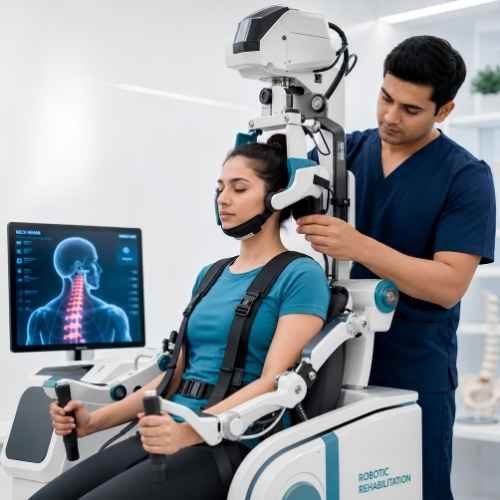
Stage 2 — Robotic Upper Cervical Mobilization & Joint Restoration (Sessions 8–16)
Once suboccipital tension has been sufficiently reduced, our computer-guided robotic mobilization system is introduced to specifically target the C1-C2 and C2-C3 facet joints — the precise segments responsible for most cervicogenic vertigo signaling. Precise, tension-monitored robotic movements restore normal joint play to these upper cervical segments, correcting the distorted positional input being sent to the brain. The robotic system's real-time biofeedback ensures every movement stays within safe tissue tolerance, preventing any provocation of dizziness during treatment. This stage restores full, confident neck rotation without triggering symptoms.
Stage 3 — Cervical Proprioceptive Retraining & Postural Re-education (Sessions 16–24)
The essential final stage — most commonly skipped in conventional clinics. This phase uses targeted proprioceptive retraining exercises to recalibrate the relationship between cervical positional signals, vestibular input, and visual tracking, helping the brain relearn an accurate, consistent sense of head position. Combined with deep cervical flexor training, scapular stabilization, and ergonomic correction for laptop and desktop use, this stage eliminates the postural trigger that initiated the dizziness cycle. Without this stage, patients with desk-based jobs consistently see their cervicogenic vertigo symptoms return within months.
Patient Questions